



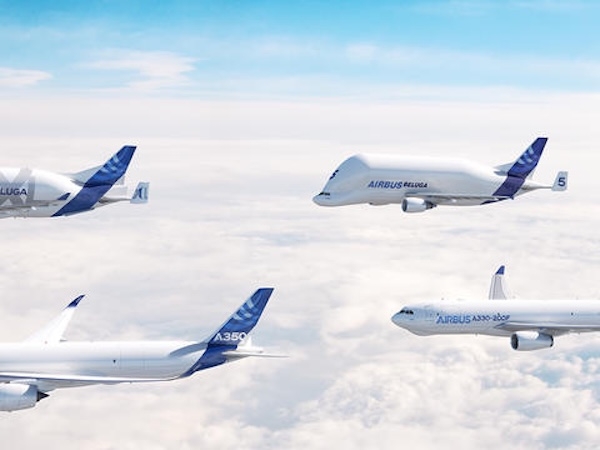
Airbus’ 2025 Cargo Global Market Forecast shows the worldwide fleet of dedicated freighter aircraft rising to 3,420 in the next 20 years, equivalent to a 45% increase. This will be made up of 815 existing freighters and 2,605 additional ones. Of these additional 2,605 freighters, 1,530 will be replacements and 1,075 will be for growth. The additional 2,605 will be split between 1,120 small aircraft, 855 mid-size widebodies, and 630 large widebodies. Overall of the 2,605 additional freighters, 1,670 will be conversions from passenger aircraft and 935 will be new-build freighters.
World Gross Domestic Product and trade remain the main drivers of air cargo. With long term trade forecasted at 2.7% CAGR, Airbus forecasts that air cargo will develop at a rate of 3.3% annually over the next 20 years, effectively almost doubling cargo volumes over the next two decades. Airbus forecasts significant air cargo growth as it has proved essential - not just to support economies, but also to connect remote communities, transport essential and health-critical goods, and enable local business development in emerging countries.
After rapid cargo fleet growth during the pandemic, fuelled by an increase of passenger aircraft conversions into freighters and minimum retirement of previous generation freighters, Airbus forecasts that going forward, a large proportion of these older freighters will leave the fleet and be replaced by newer, more fuel efficient freighters such as the A350F or A320/A321 and A330 Passenger-to-Freighter conversions.
Airbus also forecasts trade lanes, and therefore air cargo flows diversification, as more countries in the Asia-Pacific region become industrial centres. Likewise, GDP and demographic forecasts indicate that new countries such as Brazil, Indonesia or Vietnam will emerge as major consumer economies in the coming decades. This will initiate a gradual shift in air cargo geography and the global air freight map.
Of the total need for 2,605 freighter deliveries over the next 20 years, Asia-Pacific and North America will account for nearly two-thirds of demand, requiring 850 and 920 aircraft, respectively.

Azerbaijan Airlines (AZAL), part of AZCON Holding, has taken delivery of another Airbus A321neo, increasing its fleet to 31 aircraft as the carrier continues its long-term modernisation strategy. The...
Tecnam introduces the P2008JC NG to the United States market, bringing flight schools a certified, next-generation training aircraft designed to dramatically reduce operating costs while maximizing fl...
Rising production rates and the launch of new aircraft programs are driving increased demand for manufacturing capacity across the aerospace industry. To support this growth, FACC plans to i...
Etihad Airways has signed an interline agreement with Nigerian airline Ibom Air, enabling travellers to connect seamlessly beyond Lagos and Accra to five destinations across Nigeria on a single t...

