



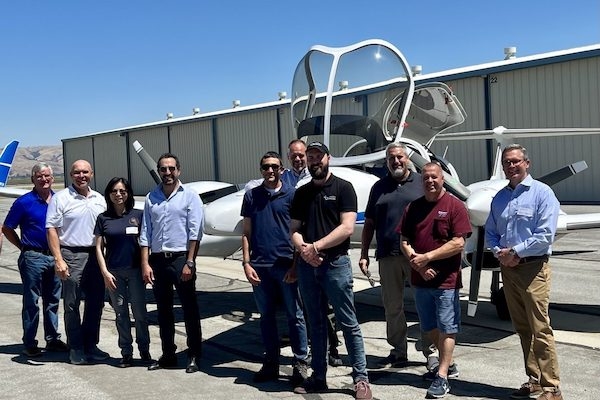
ANRA Technologies has been conducting tests supporting FAA Urban Air Mobility airspace management demonstration project that recently culminated with live flights in California. In collaboration with other industry partners, ANRA successfully provided airspace management services for the Aurora Flight Sciences, a Boeing Company, optionally piloted Centaur aircraft that flew the 20-mile corridor between St Martin and Hollister airports in central California.
David Murphy, UAMD Project Lead for ANRA, commented: “There have been many meetings, numerous simulations and plenty of tests to ensure the safe operation of real aircraft flying while connected to the ANRA platform in the NAS. The ANRA PSU, DCB and DSS worked great, but we have much more to learn on how we continue to integrate UAM operations in today’s air traffic system.”
The demonstration highlighted and validated UAM concepts to include exhibiting airspace management of UAM corridors and architecture components that support data exchanges in the ecosystem. The actions were performed in a dynamic environment wherein TFM constraints were placed on constrained resources within the operational corridor. In turn, the instantaneous status of the corridor’s resources was exchanged back to TFM, thereby closing the feedback loop of CFM’s response to TFM constraints. ANRA, and industry partners, shared information through standardized message protocols about each other’s hosted aircraft operations, providing demand capacity balancing technology and airspace management services to ensure corridor utilization did not exceed CFM or TFM management capabilities.
The testing included introducing corridor entry points that served as the points the aircraft used to transition to and from corridors enabling TFM and CFM. ANRA was responsible for deconflicting and managing the Centaur aircraft with another participating UAM aircraft provided by Reliable Robotics and simulated traffic. This operation was accomplished using the Federated Service Network that enabled information exchange between PSUs and FAA assets.
Industry technology partners included Reliable Robotics, Aurora Flight Sciences, a Boeing Company, and OneSky. Texas A&M University Corpus Christi Lone Star UAS Center of Excellence & Innovation provided test site operator support and Embry Riddle Aeronautical University was the overall project manager. The FAA was the project sponsor and provided air traffic controller expertise and support from their NexGen Integration and Evaluation Capability laboratory.
flyadeal, the fast-growing low-cost carrier of Saudia Group and one of the GCC's largest budget airlines, has expanded its presence in India with the launch of non-stop flights between Riyadh and...
Rising production rates and the launch of new aircraft programs are driving increased demand for manufacturing capacity across the aerospace industry. To support this growth, FACC plans to i...
UH-60 Black Hawk helicopters operated by Helicopter Alliance played a vital role in combating wildfires across Central and Southern Europe during the aerial firefighting season that has now concluded....
In a landmark step towards next-generation regional aircraft manufacturing, Jungheinrich has delivered an advanced automated logistics centre to Deutsche Aircraft at Leipzig/Halle Airport. Supporting...

