



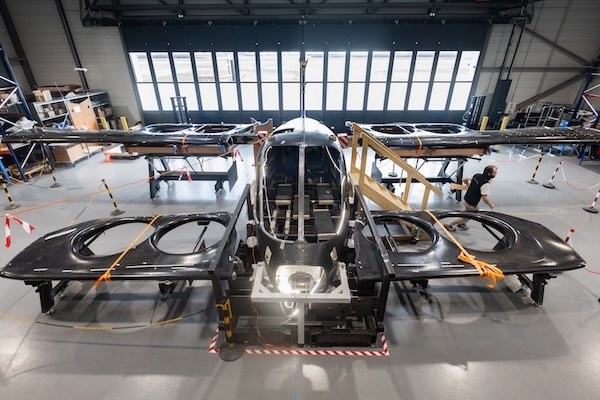
Ascendance ATEA aircraft has entered its final integration phase, with the completion of the demonstrator's structure at its Toulouse facility. Engineered under the direction of Ascendance's teams and manufactured by DUQUEINE Group - an industrial partner specializing in aeronautical composite structures - this strategic milestone marks the culmination of years of design work, aerodynamic optimization, and industrialization.
Alongside ATEA 's development, Ascendance is already putting its STERNA hybrid-electric technologies to work with partners, notably in the drone sector as well as for civil aviation. These collaborations validate the hybrid architecture in operational environments, demonstrate its robustness across diverse mission profiles, and accelerate the industrial maturity of the technology. ATEA is thus part of a continuous journey: it serves as both an integrated demonstrator and a technology catalyst for civil and defense applications.
Prior to the launch of prototype production, ATEA' architecture underwent advanced design campaigns, structural analyses, aerodynamic studies, and wind tunnel testing. This work validated the architectural choices specific to a hybrid VTOL aircraft integrating distributed propulsion and fly-by-wire flight controls.
Jean-Christophe Lambert, CEO, Ascendance commented: "ATEA's entry into its final integration phase is a particularly significant moment for our teams. It brings to life years of design, hybrid-electric propulsion testing, and avionics validation. ATEA is not just an aircraft — it is the demonstrator of a complete architecture combining hybrid-electric propulsion, distributed propulsion, and fly-by-wire flight controls. This is proof that our conviction around hybrid-electric aviation is taking shape. It is not simply a vision for the future of aviation, it is a pragmatic, operational solution to accelerate decarbonization and strengthen our position in this critical sector of aerospace."

With the structure now in place, full integration can begin of:
This milestone marks the transformation of an engineering program into a tangible industrial reality. ATEA 's entry into integration is not a starting point — it is the outcome of a four-year maturation cycle. Ascendance hybrid propulsion system has undergone four years of continuous bench testing (over 500 hours), validating its architecture, technologies and equipment, reliability, and performance.
In parallel, avionics systems and flight control laws were tested through advanced flight simulations integrating the full operational chain: complete cockpit, integrated onboard systems, and ground communications. These campaigns were conducted with Ascendance's test pilots and also involved EASA-certified pilots, contributing to the robustness of the control architecture and its compliance with regulatory requirements.
Photo credit: Rémi Benoit

PAL-V has signed a Memorandum of Understanding with AVION, a specialist in advanced flight training devices, and FLYVE, a developer of FlyDrive ecosystems for professional and government operator...
TRU Simulation + Training Inc. will showcase its Veris Virtual Reality Flight Training Device (FTD) for the Cessna Skyhawk at NBAA-BACE 2026, marking the simulator's first appearance at the indust...
Emirates has officially inaugurated services to Helsinki, marking a significant milestone in connectivity between Finland and the United Arab Emirates. The new daily route is the only year-r...
Azerbaijan Airlines (AZAL), part of AZCON Holding, has taken delivery of another Airbus A321neo, increasing its fleet to 31 aircraft as the carrier continues its long-term modernisation strategy. The...

