



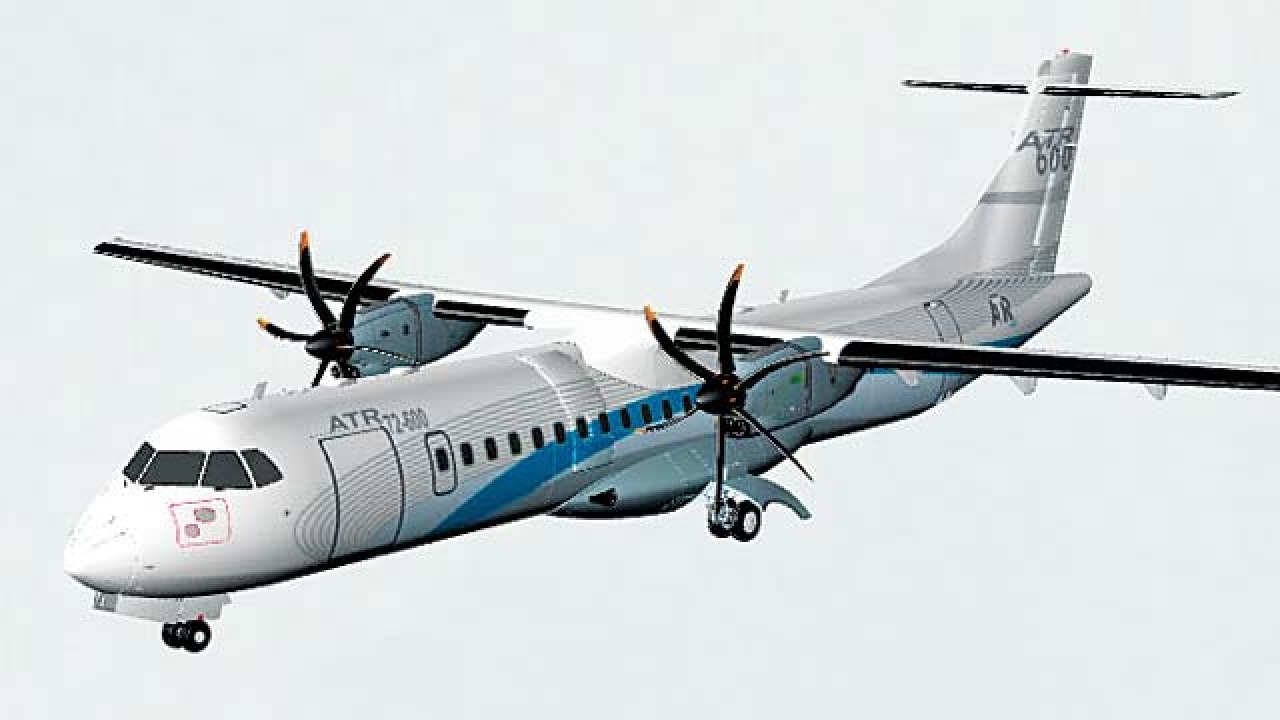
ATR, the world’s leading turboprop manufacturer, is taking part in the EDG²E project (Equipment for Dual frequency Galileo, GPS and EGNOS). Over the next four years, this initiative will develop a dual-frequency multi-constellation receiver, enabling enhanced navigation capabilities. EDG²E is a project led by Thales, under a consortium benefiting from the competencies of ATR and Thales Alenia Space. AKKA, Dassault and DGAC, the French Civil Aviation Authority, will also participate as sub-contractors.
The receiver, a GNSS (Global Navigation Satellite System), is the cornerstone of aircraft navigation. The system processes signals from satellite constellations and the Space Based Augmentation System (SBAS) to accurately determine aircraft position, altitude and velocity. The prototype receiver developed under the auspices of the EDG²E project will use signals from US GPS and European Galileo positioning systems, as well as from SBAS multi-constellation EGNOS. The project aims at achieving a prototype demonstration by 2021. The prototype receiver performances will be evaluated during a flight test campaign to be performed using one of the ATR’s test aircraft.
Initiated by the European Global Navigation Satellite Systems Agency (GSA), the EDG²E project aims to support the launch of the Galileo satellites constellation, designed to become the European alternative for the American GPS. ATR’s involvement in this Research & Technology (R&T) project is part of a larger commitment to prepare for the future. By steering R&T activities towards technical topics and solutions that are specific to regional aviation, ATR wants to continuously improve the technical design of its products.
Commenting on the EDG²E project, Alessandro Amendola, SVP Engineering of ATR, declared: “The ATR aircraft, as the most modern regional aircraft, is perfectly suited to take part in this innovative EU project. We are proud of being part of the development of a new system which will clearly enhance the navigation capabilities of tomorrow’s aircraft”.
Philippe Benquet, Thales Avionics VP for R&T, declared: “Leading the EDG²E project, at ATR side, puts Thales at the forefront of the next generation receivers which will equip future aircraft by 2025. This initiative will make navigation more precise and thus safer, unleashing potential for increased air traffic”.
EGNOS has been certified for use in aviation since February 2011, and is a very effective system to complement the US GPS, in order to provide better performance, thus enhancing aircraft approach capabilities. The next generation of EGNOS, called EGNOS V3, will further enhance performance by complementing both the EU Galileo and the US GPS satellite navigation constellations.
At the end of the EDG²E project, a new standard for GPS, Galileo and SBAS receiver will be completed, with aviation’s first SBAS dual-frequency GPS and Galileo receiver being ready for final development. Receivers developed under the EDG²E initiative will provide safer operations not only for the aviation sector but also for other safety-critical applications like rail transport.
Emirates has officially inaugurated services to Helsinki, marking a significant milestone in connectivity between Finland and the United Arab Emirates. The new daily route is the only year-r...
UH-60 Black Hawk helicopters operated by Helicopter Alliance played a vital role in combating wildfires across Central and Southern Europe during the aerial firefighting season that has now concluded....
Dutch flag carrier KLM, part of the Air France-KLM Group, has welcomed its first Airbus A350-900, marking a significant step in the airline’s long-haul fleet modernization strategy. The arrival...
flyadeal, the fast-growing low-cost carrier of Saudia Group and one of the GCC's largest budget airlines, has expanded its presence in India with the launch of non-stop flights between Riyadh and...

