



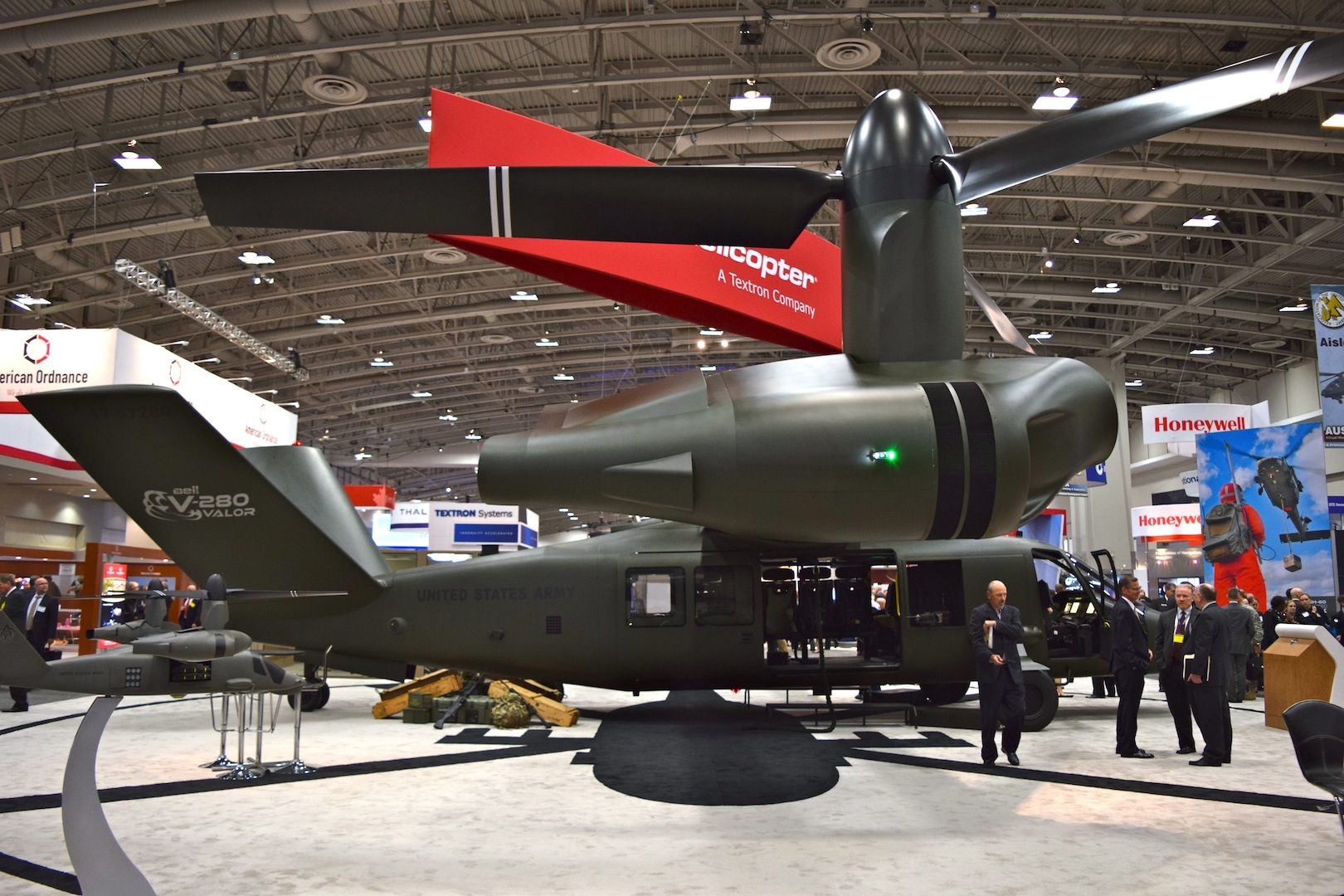
Bell Helicopter begins 2016 with final assembly of its V-280 next-generation tiltrotor 23% complete and on target for first flight in September 2017, with the next major milestones being mating of the wing and fuselage in April.
The company’s VP of advanced tiltrotor systems Vince Tobin says the straight, composite wing for the US Army technology demonstrator is almost fabricated, including the electrical wiring and hydraulics, and the fuel bladders will go in last. The 11-member industry team is also preparing the nacelles to receive gearboxes and eventually GE Aviation T64-419 engines.
“Twenty-fifteen was really the transition from designing it and setting up teammates to assembly,” Tobin tells Flightglobal in an interview. “This year is essentially everything short of being able to turn the rotors on the airplane.”
In 2015, Spirit AeroSystems delivered the V-280 composite fuselage to Bell’s Amarillo, Texas plant for final assembly.
Spirit AeroSystems
The team aims to “turn rotors” on the Valor and verify all the subassemblies in the first half 2017.
“We’ll do the restrained ground run, and that essentially says you have an airplane that could fly,” he says. “That will be April of 2017, and then the wheels will actually break ground.”
The company is looking at different ways to speed up the assembly process, since it’s an advanced concept demonstrator and not the exact, final design. Tobin says the "model performance specification" file of the ultimate V-280 continues to be refined as the army ponders its requirements for the follow-on Future Vertical Lift programme.
Once flying starts, Tobin wants the army to move quickly and transition to a development programme, given the significant industry investment.
“Our expectation is that we would be able to enter the acquisition cycle at Milestone B and go right into engineering and manufacturing development (EMD),” he says. “We would be ready to do that as soon as a few months after we go fly.
“There are very few of our technologies that are below technology readiness level six (TRL-6) at that point, so by definition we’re ready for EMD.”
Bell Helicopter
The V-280 is one of two next-generation rotorcraft designs being demonstrated for FVL, which aims to introduce a new high-speed, long-range aircraft to succeed the Sikorsky UH-60 Black Hawk and Boeing AH-64 Apache. Valor is competing against the Sikorsky-Boeing SB-1 Defiant – a rigid coaxial-rotor compound helicopter derived from the Sikorsky X2.
No funding has been allocated for FVL thus far, but the army expects to firm its performance requirements once the demonstrators fly.
FVL might not surface in the army’s upcoming fiscal year 2017 budget submission, but Bell hopes funding will be made available in 2018 or 2019 to get things moving.
“Sooner is better,” Tobin says. “We’re in the philosophy of ‘build it and they will come’. If we build it and they don’t come, the opportunity to get companies to feel comfortable about doing this again in the future will be diminished, so we really hope this works.”
Private jet catering requires an understanding of the journey as much as the passengers' preferences. SkyDine Jet Catering explores how flight duration, departure schedules, airport location, and...
Few infrastructure projects have the potential to reshape an island's future quite like the ongoing transformation of Nevis Airport. To gain deeper insight into this ambitious development and the...
Airbus 2026 Cargo Global Market Forecast, unveiled at the Cargo Facts Symposium, predicts that the global fleet of dedicated freighter aircraft will expand by 46%, rising from 2,360 aircraft in 2026 t...
Lufthansa Technik Engine Services (LTES) is significantly expanding its engine maintenance capabilities in Tulsa, Oklahoma, nearly doubling its operational capacity as part of its growth strategy acro...

