



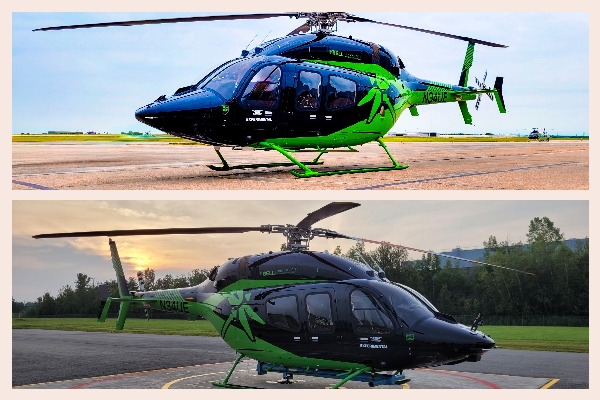
Bell Textron revealed its Aircraft Laboratory for Future Autonomy based on the Bell 429 commercial aircraft. Developed by Bell Advanced Programs team, ALFA is dedicated to performing flight maneuvers with an aircraft safety system and executing autonomous fly-by-wire flights. The fly-by-wire integration was a critical step in future development of autonomous controls for Bell’s commercial aircraft, an emerging technology that aims to reduce pilot workload and enhance safety.
Jason Hurst, executive vice president, Engineering, Bell commented: “Fly-by-wire flight, coupled with additional capability that are being integrated into ALFA, provide a great foundation for Bell to expand on its autonomous capabilities. This aircraft will serve as a flying lab that will inform future autonomous technology development, which we can ultimately leverage to deliver the best rotorcraft solutions to global operators.”
ALFA aircraft safety system separates safety functions from flight control functions, allowing for rapid development and evaluation of novel flight control technology without compromising overall safety. The aircraft completed its first flight at Bell’s Commercial Assembly and Delivery Centre in Mirabel, Quebec, Canada and is now being used for further exploration at Bell’s Flight Research Center in Fort Worth, Texas.

Dutch flag carrier KLM, part of the Air France-KLM Group, has welcomed its first Airbus A350-900, marking a significant step in the airline’s long-haul fleet modernization strategy. The arrival...
A new travel industry coalition is urging EU policymakers to adopt a balanced and proportionate approach to biometric travel, ensuring passengers can benefit from secure and seamless journeys while ma...
UH-60 Black Hawk helicopters operated by Helicopter Alliance played a vital role in combating wildfires across Central and Southern Europe during the aerial firefighting season that has now concluded....
For the fourth consecutive year, Corsair is reaffirming its commitment to the fight against breast cancer by partnering with the association "Les Hôtesses de l’Air cont...

