



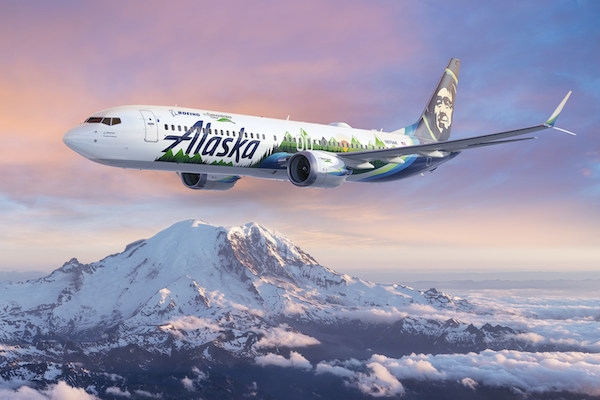
Boeing and Alaska Airlines announced they are partnering on the latest Boeing ecoDemonstrator program and will flight test about 20 technologies on a new 737-9 to enhance the safety and sustainability of air travel.
In flights beginning this summer, Boeing and Alaska will test a new halon-free fire-extinguishing agent that significantly reduces effects on the ozone layer, evaluate an engine nacelle designed to reduce noise and assess cabin sidewalls made from recycled material, among other projects.
"We have a long history of working with Boeing to advance aviation technology, safety and fuel efficiency," said Diana Birkett Rakow, Alaska Airlines' vice president, public affairs and sustainability. "Alaska Airlines flies to some of the most beautiful and geographically diverse regions in the world and we are committed to finding ways to reduce climate impacts across our network. This work with Boeing to accelerate innovation on the ecoDemonstrator program enables us to contribute to a more sustainable future for our global community."
Since 2012, the ecoDemonstrator program has accelerated innovation by taking nearly 200 promising technologies out of the lab and testing them in the air to address challenges for the aviation industry and improve the passenger experience.
"Boeing is committed to continually improve air safety and the environmental performance of our products," said Stan Deal, Boeing Commercial Airplanes president and CEO. "We're proud to collaborate with our hometown customer and other partners around the world this year to make flying more sustainable."
In five months of ecoDemonstrator flight tests, Boeing and Alaska will work with nine other partners to test new technologies. After tests are complete, the airplane will be configured for passenger service and delivered to Alaska. The program's technologies include:
Boeing's current and future airplanes leverage a number of technologies evaluated in previous ecoDemonstrator testing, including:
"Boeing put additional emphasis on sustainability in 2020 to align with our stakeholder and business priorities as well as our values," Boeing Chief Sustainability Officer Chris Raymond said. "Through our collaboration with industry partners, the ecoDemonstrator program is a great example of our commitment to work together to make flying safer and more sustainable for current and future generations."
ecoDemonstrator test flights are flown on a blend of petroleum-based and sustainable aviation fuel. SAF is in regular use today, reduces life-cycle CO2 emissions by up to 80%, and offers the most immediate and greatest potential to reduce emissions over the next 20 to 30 years in all commercial aviation markets.
In January this year, Boeing committed to make sure its commercial airplanes are capable and certified to fly on 100% SAF by 2030. The company also plans to work with regulatory authorities and across the industry to raise the current 50% blending limit for expanded use of SAF. Boeing's 2018 ecoDemonstrator 777 Freighter made history as the world's first commercial airliner to fly on 100% sustainable fuel.
For the fourth consecutive year, Corsair is reaffirming its commitment to the fight against breast cancer by partnering with the association "Les Hôtesses de l’Air cont...
TRU Simulation + Training Inc. will showcase its Veris Virtual Reality Flight Training Device (FTD) for the Cessna Skyhawk at NBAA-BACE 2026, marking the simulator's first appearance at the indust...
Rising production rates and the launch of new aircraft programs are driving increased demand for manufacturing capacity across the aerospace industry. To support this growth, FACC plans to i...
The International Aircraft Dealers Association (IADA) has released its 2026-2027 Current Market Portrait & Forecast, offering an in-depth analysis of the global preowned business av...

