

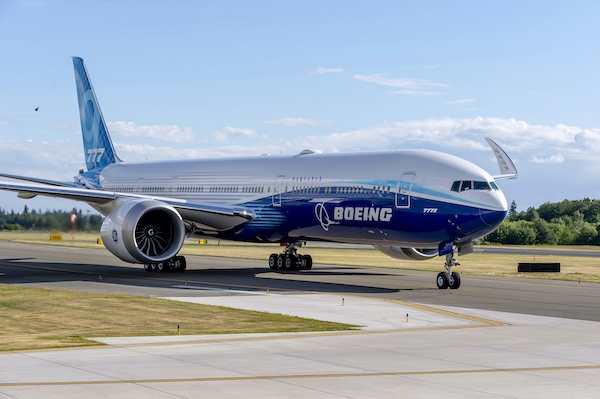
With demand rebounding for international air travel following ongoing recovery in many domestic markets, Boeing projected demand for more than 41,000 new airplanes through 2041, underscoring aviation industry resilience two years after the pandemic began. Boeing released its 2022 Commercial Market Outlook (CMO), the company's annual long-term forecast, in advance of the Farnborough International Airshow.
The CMO forecasts a market value of $7.2 trillion for new airplane deliveries, with the global fleet increasing by 80% through 2041 compared to 2019 pre-pandemic levels. Approximately half of passenger jet deliveries will replace today's models, improving the global fleet's fuel efficiency and sustainability. In addition, Boeing Global Services forecasts $3.6 trillion in demand in its market segments over the same time period, including strong demand for maintenance and modifications such as converted freighters; digital solutions that increase efficiency and reduce cost; and effective training to enable the supply of pilots and technicians.
"Despite the unprecedented disruption over the past two years, the aviation industry has shown incredible resilience adapting to the challenge," said Ihssane Mounir, Boeing's senior vice president of Commercial Sales and Marketing. "The 2022 CMO draws upon our expertise forecasting market trends to demonstrate the strong demand for new airplanes and related services in the coming decades, providing a waypoint as the industry continues to navigate its recovery."
The 2022 CMO includes these regional projections in the next 20 years:
Single-aisle airplanes will account for 75% of all new deliveries, unchanged from last year's CMO, and totaling nearly 31,000 airplanes. Through 2041, new widebody airplanes will account for about 18% of deliveries with more than 7,200 airplanes, enabling airlines to serve new and existing markets, passenger and cargo, more efficiently than in the past.
The CMO also predicts continued robust demand for dedicated freighters to support global supply chains and growing express networks. Carriers will need 2,800 additional freighters overall, including 940 new widebody models in addition to converted narrow-body and widebody freighters over the forecast period.
|
NEW DELIVERIES (2022-2041) |
|
|
Regional Jet |
2,120 |
|
Single Aisle |
30,880 |
|
Widebody |
7,230 |
|
Freighter |
940 |
|
Total |
41,170 |
Boeing has provided the CMO annually for more than 60 years. As the longest-running jet forecast, the CMO is regarded as the most comprehensive analysis of the commercial aviation industry. Learn more about the Commercial Market Outlook. In addition, Boeing will release its Pilot and Technician Outlook on July 25.

MTU Maintenance and Garuda Indonesia have entered into a three-year agreement for the maintenance, repair and overhaul of the airline’s GE90-115B engines, which power its fleet of eight Boeing 7...
The U.S. Federal Aviation Administration has certified the Boeing 737-10, the newest and largest member of the 737 MAX family, paving the way for Boeing [NYSE: BA] to begin customer deliveri...
Archer Aviation has unveiled plans to develop three air taxi networks across Austin, Dallas-Fort Worth and Houston, aiming to improve connectivity between major airports, business centers and key regi...
Electra has successfully completed the takeoff and landing of its hybrid-electric Ultra Short aircraft at Downtown Skyport in Lower Manhattan, in what is believed to be the first time a fixed-wing air...