



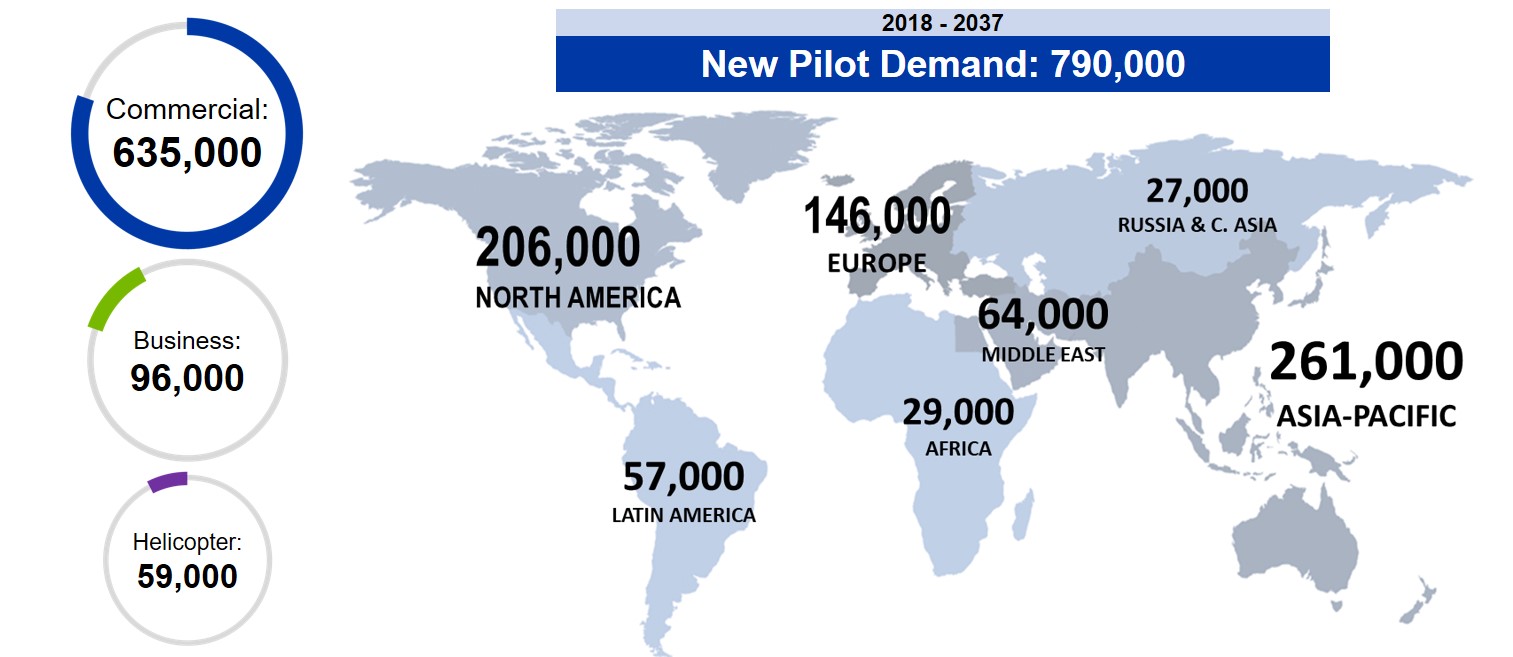
2018 Pilot & Technician Outlook forecasts a 20-year demand for 790,000 pilots
Study cites fleet growth rates and tightening labor supply among reasons for increasing shortages
Boeing training and crew solutions offer operators support for staffing challenges
Boeing released its 2018 Pilot & Technician Outlook, projecting demand for 790,000 pilots over the next 20 years. This represents double the current workforce and the most significant demand in the outlook's nine-year history.
The demand is being driven by an anticipated doubling of the global commercial airplane fleet — as reported in Boeing's Commercial Market Outlook — as well as record-high air travel demand and a tightening labor supply. This year's outlook also includes data from the business aviation and civil helicopter sectors for the first time.
"Despite strong global air traffic growth, the aviation industry continues to face a pilot labor supply challenge, raising concern about the existence of a global pilot shortage in the near-term," said Keith Cooper, vice president of Training & Professional Services, Boeing Global Services. "An emphasis on developing the next generation of pilots is key to help mitigate this. With a network of training campuses and relationships with flight schools around the globe, Boeing partners with customers, governments and educational institutions to help ensure the market is ready to meet this significant pilot demand."
Boeing offers the Pilot Development Program – an accelerated training program that guides future pilots from early stage ab-initio training through type rating as a first officer – to help operators meet their growing pilot needs. Boeing also helps operators improve crew efficiency with tools that optimize resources and minimize disruption.
Despite the commercial pilot demand forecast holding nearly steady, maintenance technician demand decreased slightly from 648,000 to 622,000, primarily due to longer maintenance intervals for new aircraft. Collectively, the business aviation and civil helicopter sectors will demand an additional 155,000 pilots and 132,000 technicians.
Demand for commercial cabin crew increased slightly from 839,000 to 858,000, due to changes in fleet mix, regulatory requirements, denser seat configurations and multi-cabin configurations that offer more personalized service. In addition, 32,000 new cabin crew will be required to support business aviation.
For more information about the Pilot & Technician Outlook, please visit: http://www.boeing.com/commercial/market
For the 2018 Business Environment Update, please visit: http://www.boeing.com/commercial/market/boeing-market-insight
In a landmark step towards next-generation regional aircraft manufacturing, Jungheinrich has delivered an advanced automated logistics centre to Deutsche Aircraft at Leipzig/Halle Airport. Supporting...
Etihad Airways has signed an interline agreement with Nigerian airline Ibom Air, enabling travellers to connect seamlessly beyond Lagos and Accra to five destinations across Nigeria on a single t...
TRU Simulation + Training Inc. will showcase its Veris Virtual Reality Flight Training Device (FTD) for the Cessna Skyhawk at NBAA-BACE 2026, marking the simulator's first appearance at the indust...
Foster Aviation, the Dubai-based provider of Advanced Air Mobility and aviation solutions, and Aeroberm, a Skyportz company and developer of the patented modular vertipad system, have announced a...

