



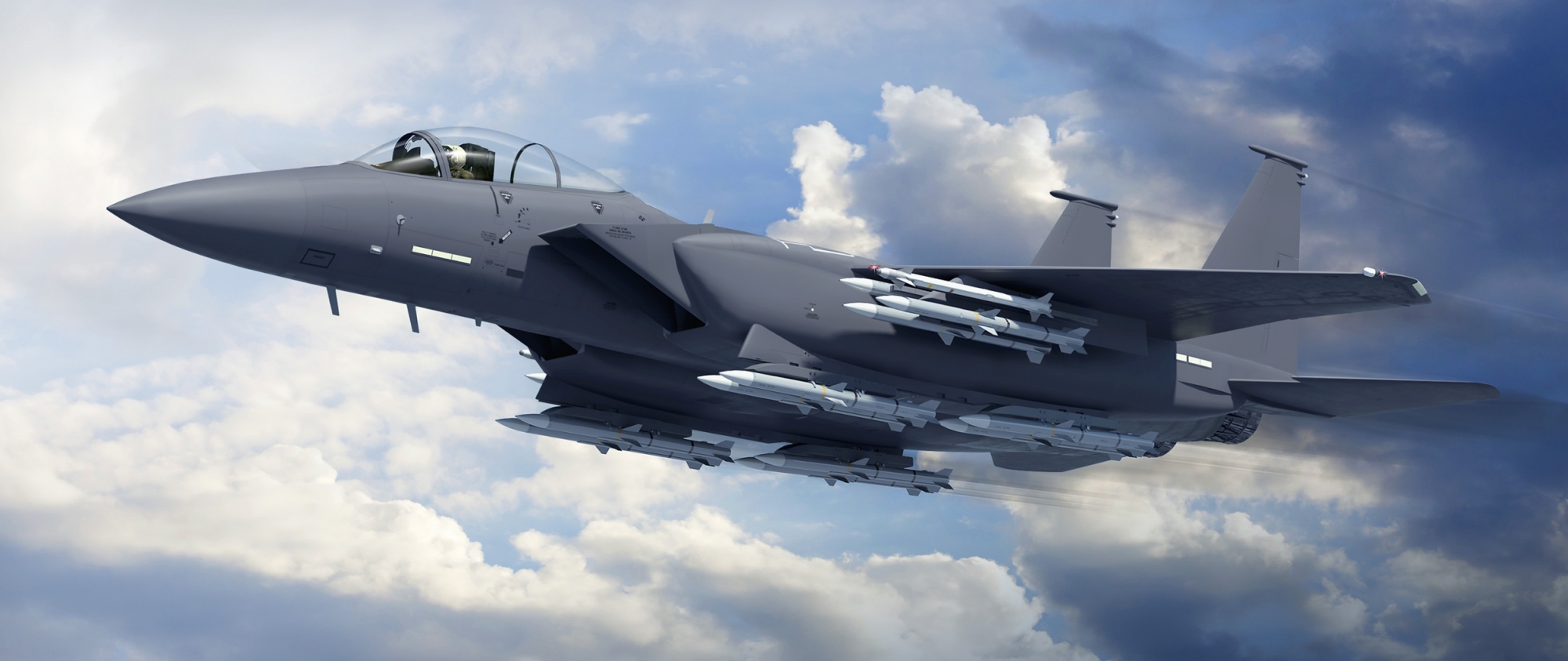

Boeing is proposing an “F-15 2040C” series of upgrades that would extend the life of the fourth-generation F-15C air superiority fighter to complement the fifth-generation F-22 Raptor. The 2040 version would double to 16 the number of air-to-air missiles the fighter carries, extend its range and improve its lethality and survivability with upgraded electronics.
An F-15 2040C would also extend the fighter’s production line in St. Louis, which with 84 F-15SAs destined for Saudi Arabia has firm orders through 2019. Boeing previously offered a stealthy “Silent Eagle” version for South Korea’s F-X III fighter competition, but that country last year settled on the Lockheed Martin F-35A Lightning II for the requirement.
At the recent Air Force Association conference in National Harbor, Md., Boeing said it has conducted an internal study of upgrading the F-15C to serve as a cohort to Lockheed Martin’s F-22. The U.S. Air Force originally sought as many as 750 F-22s, but the U.S. government ultimately stopped production in 2011 at 187 operational fighters. Boeing now seeks to fill a perceived gap in air superiority capability with an upgraded F-15C.
“There’s a real challenge that the U.S. faces with air superiority because the next generation air dominance platform is not intended to be fielded until the mid-2030s, and it won’t be out there in numbers until roughly the 2040 time frame to start replacing the fleet,” said Mike Gibbons, Boeing vice president of F-15 programs. “That means the U.S. Air Force has the F-15s and the F-22s they have today to perform the air superiority mission.”
The F-15 2040C would be a menu offering of F-15 program of record and proposed upgrades. “We’re not providing it as a single proposal to the U.S. Air Force,” said Gibbons, who added that Boeing is providing the service with analysis and cost and time estimates of possible improvements. “We expect if they head down this path, they won’t be left to do it all in one [budget] cycle. It’s very likely this would be a set of upgrades to the jet,” he said.
The package would incorporate the programmed radar upgrade of F-15C/Ds with the Raytheon APG-63(v)3 active electronically scanned radar and a new electronic warfare suite called EPAWSS, for the Eagle Passive/Active Warning and Survivability System. A proposed long-range infrared search and track sensor podwould complement the AESA radar. Boeing supplies conformal fuel tanks on the multi-role F-15E Strike Eagle; the 2040C upgrade would add them on the F-15C. The proposed weapons load increase would be accomplished by adding a Boeing-developed “quad pack” carriage system on two weapons stations. A communications and networking pod with advanced datalinks, now being demonstrated under the Air Force’s Talon HATE program, would enable the older F-15 to interact with the Raptor and other platforms.
“These are critical capabilities that are not important to the F-15 alone; they’re really a nice complement to what the F-22 has,” Gibbons said. “The F-22 is an incredible platform by itself. When you bring in an F-15 that’s got more weapons, a long-range sensor that is in a different frequency band than what the F-22 carries, the extended range and the connectivity to the F-22 and other systems—that is a huge increase in capability.”
Avelo Airlines reached a major milestone, flying its 10 millionth Customer just five years after redefining affordable air travel in as America's most convenient airline. Since launching on April...
Air India, SkyDrive and Suzuki Motor Corporation signed a memorandum of understanding to conduct a joint feasibility study on the use of eVTOL aircraft for medical air logistics in India. In...
Eve Air Mobility completed its first partial transition flight, marking an important milestone in the development and testing of the company' eVTOL aircraft. The flight involved the acti...
Atoms and Joby Aviation announced a strategic partnership to acquire and develop vertiport sites in the United States. The companies will initially focus on Florida, New York, and Texas, the markets w...
