



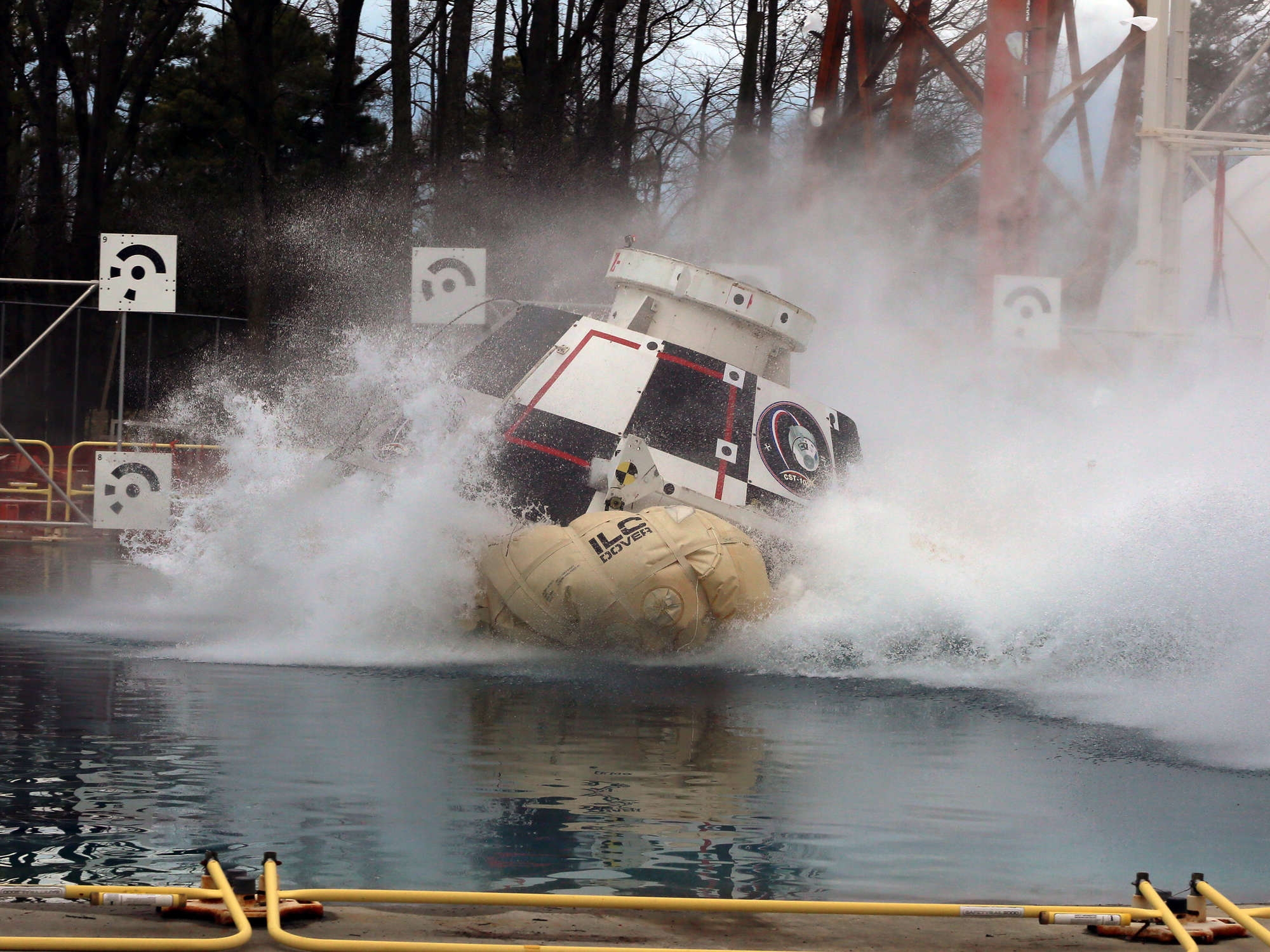
Boeing and SpaceX are racing to become the first private companies to carry astronauts into space, as early as next year.
And although SpaceX is generally considered to be leading the race (it already delivers supplies to the space station), Boeing shouldn't be underestimated (the company built most of the International Space Station).
After carrying astronauts to space, Boeing's crew capsule, the CST-100, a.k.a. "Starliner", would use parachutes to land softly on the ground. But in some emergency situations, it might need to land in water, which is why the company recently dropped the Starliner into the 20-foot-deep pool at NASA’s Langley Research Center.
Boeing performed similar tests in August 2015--watch it get flung from a crane. Engineers like to do these tests from different heights and angles to account for all scenarios. No word yet on how the Starliner performed, but chances are, if it's built to handle going to space and back, it can handle a little water.
Following the successful public flight demonstrations at Expo 2025 Osaka, SkyDrive announced plans to undertake a feasibility study exploring the conversion of Osaka City’s existi...
The International Aircraft Dealers Association (IADA) has released its 2026-2027 Current Market Portrait & Forecast, offering an in-depth analysis of the global preowned business av...
UH-60 Black Hawk helicopters operated by Helicopter Alliance played a vital role in combating wildfires across Central and Southern Europe during the aerial firefighting season that has now concluded....
Dutch flag carrier KLM, part of the Air France-KLM Group, has welcomed its first Airbus A350-900, marking a significant step in the airline’s long-haul fleet modernization strategy. The arrival...

