



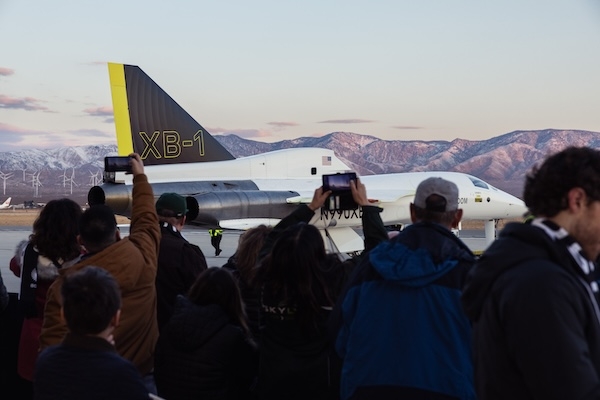
Boom Supersonic announced successful first supersonic flight of its XB-1 demonstrator aircraft at the Mojave Air & Space Port in California. Boom designed, built, and flew the world’s first independently developed supersonic jet—the first civil supersonic jet made in America. Flown by Boom Chief Test Pilot Tristan “Geppetto” Brandenburg, XB-1 entered the supersonic corridor and reached an altitude of 35,290 feet before accelerating to Mach 1.122 (652 KTAS or 750 mph) – breaking the sound barrier for the first time. Historically, supersonic aircraft have been the work of nation states, developed by militaries and governments. XB-1’s supersonic flight marks the first time an independently developed jet has broken the sound barrier.
Boom Supersonic founder and CEO Blake Scholl commented: “XB-1’s supersonic flight demonstrates that the technology for passenger supersonic flight has arrived. A small band of talented and dedicated engineers has accomplished what previously took governments and billions of dollars. Next, we are scaling up the technology on XB-1 for the Overture supersonic airliner. Our ultimate goal is to bring the benefits of supersonic flight to everyone.”
Tristan “Geppetto” Brandenburg, Chief Test Pilot for Boom Supersonic stated: “It has been a privilege and a highlight of my career to be a part of the team that achieved this milestone—every single member of this team was critical to our success. Our discipline and methodical approach to this flight test program created the safety culture that made a safe and successful first supersonic flight possible. With the lessons learned from XB-1, we can continue to build the future of supersonic travel.”

The first supersonic jet built from airliner technology, XB-1 incorporates many of the key features found on Overture, such as carbon fiber composites, digital stability augmentation, and an augmented reality vision system for landing visibility.
Following its inaugural flight in March 2024, XB-1 completed a rigorous series of 11 human-piloted test flights under increasingly challenging conditions to evaluate systems and aerodynamics. Over the course of the flight test campaign, the XB-1 team systematically expanded the flight envelope through subsonic, transonic, and supersonic speeds—while taking smart risks and maintaining safety as top priority. XB-1 provides the foundation for Overture, validating key technologies while establishing a safety-first culture. Technologies proven through XB-1’s test program that will also apply to Overture include:
XB-1’s supersonic flight took place in the same historic airspace where Chuck Yeager broke the sound barrier for the first time in 1947, among many other historic firsts. The first supersonic flight of XB-1 marks the first human-piloted civil supersonic flight since Concorde’s retirement over 20 years ago, paving the way for the return of commercial supersonic flight onboard Overture. Overture will carry 64-80 passengers at Mach 1.7, about twice the speed of today’s subsonic airliners, on over 600 global routes.
Overture has an order book of 130 orders and pre-orders from American Airlines, United Airlines, and Japan Airlines. In 2024, Boom completed construction on the Overture Superfactory in Greensboro, North Carolina, which will scale to produce 66 Overture aircraft per year. Optimized for speed, safety, and sustainability, Overture and its bespoke propulsion system, Symphony, are designed to run on up to 100% sustainable aviation fuel.

Dutch flag carrier KLM, part of the Air France-KLM Group, has welcomed its first Airbus A350-900, marking a significant step in the airline’s long-haul fleet modernization strategy. The arrival...
TRU Simulation + Training Inc. will showcase its Veris Virtual Reality Flight Training Device (FTD) for the Cessna Skyhawk at NBAA-BACE 2026, marking the simulator's first appearance at the indust...
FL Technics Indonesia, the first MRO in Indonesia to be appointed as a GE Aerospace avionics support partner, has signed a service support agreement with GE Aerospace covering Boeing 737 and Airbus A3...
British Airways has unveiled the next phase of its Heathrow lounge transformation programme, marking the beginning of a significant investment aimed at modernising every lounge across the airport in t...

