



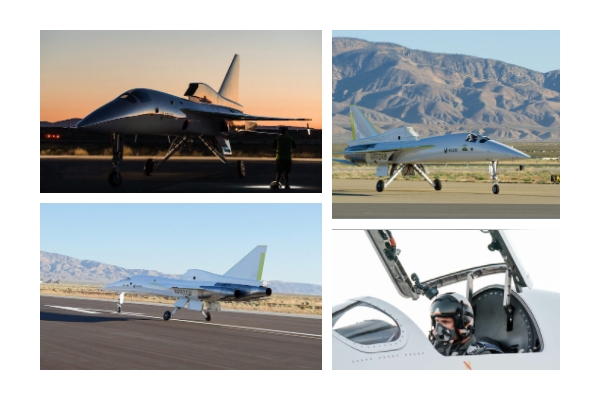
Earlier this year, XB-1 was moved from company hangar in Centennial, Colorado to Mojave Air & Space Port in Mojave, California to continue preparations for flight. The aircraft has undergone extensive ground testing since arriving, including taxi testing this week. In addition to the ongoing testing, XB-1 recently received an experimental airworthiness certificate from the FAA, following a detailed aircraft inspection. Blake Scholl, Boom Supersonic’s founder and CEO, commented: “The recent progress made towards XB-1’s first flight reflects the team’s collective efforts to build and safely fly the world’s first independently developed supersonic jet.”

Key flight authorizations secured
Boom has also secured letters of authorization to allow Chief Test Pilot Bill “Doc” Shoemaker and test pilot Tristan “Gepetto” Brandenburg to fly XB-1. Additionally, letters of agreement with airspace authorities are in place allowing for flights of the aircraft over the Mojave desert. XB-1’s historic first flight will occur in the same airspace where Captain Charles “Chuck” Yeager first broke the sound barrier in the Bell X-1 and the Mach 3+, strategic reconnaissance SR-71 “Blackbird” first flew in 1964.
Bill “Doc” Shoemaker, Chief Test Pilot for Boom Supersonic, said: “It’s fitting that XB-1 is now progressing toward first flight at the Mojave Air & Space Port, home to more than 50 first flights and other significant aviation events. I’m looking forward to flying XB-1 here, building on the achievements of other talented engineers and pilots who inspire us every day to make supersonic travel mainstream.”

In preparation for flight, Boom test pilots have completed hundreds of hours in the simulator for aircraft evaluation, operations development, training, and human factors assessments to achieve the highest levels of safety. The test pilots also maintain flight proficiency in a T-38 trainer aircraft, the same aircraft that will be used as a chase plane for all flight tests of XB-1. To further increase safety, the test pilots will use the T-38 to practice formation flying.
XB-1 leverages 60 years of progress in airplane technologies like carbon fiber composites, advanced avionics, and digitally-optimized aerodynamics. The aircraft features a carbon composite and titanium fuselage. Its ogive (modified delta) wing enables safe operation at takeoff and landing as well as supersonic speeds. The three General Electric J85 engines that power XB-1 produce a combined maximum thrust of 12,300 pounds of force. Across its development, XB-1 has validated Boom’ approach to airplane design and enabled engineers to leverage advanced tools like computational fluid dynamics which are critical components of Overture’s development. Overture is the sustainable supersonic airliner from Boom that will fly at Mach 1.7, or about twice the speed of today’s fastest airliners, and is designed to run on 100% sustainable aviation fuel.
flyadeal, the fast-growing low-cost carrier of Saudia Group and one of the GCC's largest budget airlines, has expanded its presence in India with the launch of non-stop flights between Riyadh and...
Etihad Airways has signed an interline agreement with Nigerian airline Ibom Air, enabling travellers to connect seamlessly beyond Lagos and Accra to five destinations across Nigeria on a single t...
Tecnam has announced a landmark strategic partnership aimed at accelerating the growth of its P2012 aircraft family across the United States. Under the agreement, Finnoff has been appointed the exclus...
UH-60 Black Hawk helicopters operated by Helicopter Alliance played a vital role in combating wildfires across Central and Southern Europe during the aerial firefighting season that has now concluded....

