



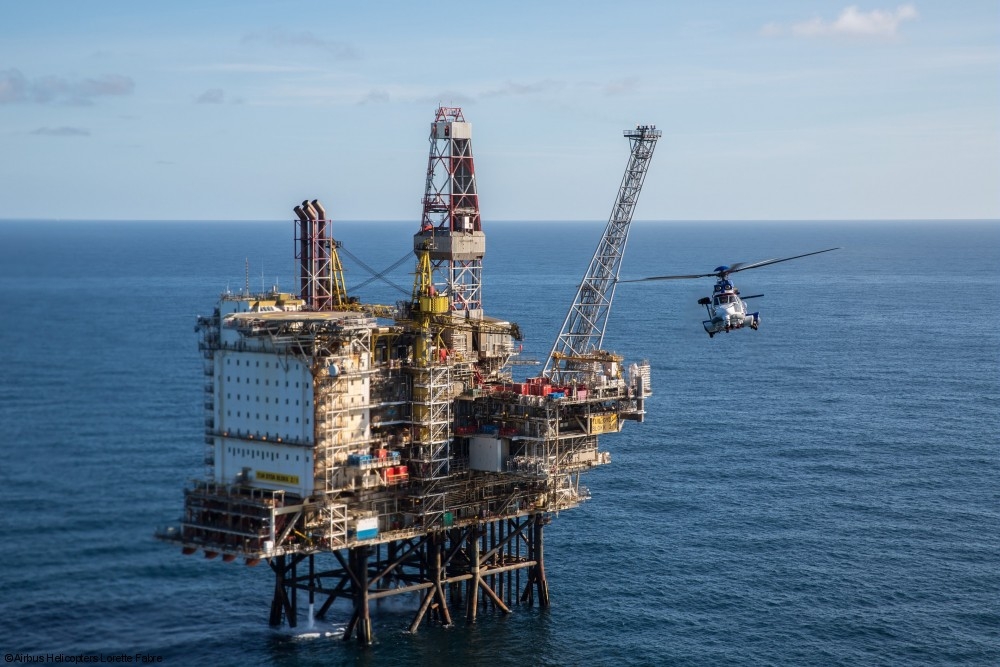
Airbus Helicopters has received EASA certification for the Rig’N Fly (Rig Integrated GPS approaches with eNhanced Fly-ability and safetY), an avionics enhancement designed to provide automatic rig approaches for offshore operations. First developed on H225. it will also be implemented on H175 (end 2016) and on H160.
Rig’N Fly uses a combination of sensors (GPS, barometric altimeter, radar altimeter, weather radar, etc.) to provide enhanced flight precision and situational awareness for automatic VMC and IMC rig approaches. The system reduces workload for pilots, allowing them to focus on monitoring flight parameters and the outside environment.
This new mode also includes offset approaches, which can be tailored according to weather conditions and oil rig environment for the safest, standardized approach, placing the helideck in the most easily visible position for the crew.
“Rig’N Fly procedures are of the utmost importance to ensure reliable operations and the safest flight conditions possible, and this is an area where Airbus Helicopters continues to focus its developments,” said Marie-Agnes Veve, head of the Super Puma and H225 programme. “With the Rig’N Fly, almost the entire approach procedure is automated, a key element in ensuring that our customers have the right technologies for safe, smooth and efficient flights.”
Using the Digital MAP (DMAP) and the Enhanced Cursor Control Device (ECCD), the pilots will have the possibility to easily modify the approach.
The DMAP brings an essential safety element as the flight plan map can be merged with additional environmental factors, including weather radar and wind data, platform locations. It also includes the Automatic Information System (AIS) that alerts the pilot if a ship is about to interfere with its planned trajectory and allowing the pilot to plan a hold to the approach or a rerouting if necessary.
The ECCD, which will also be available on the H175 and the H160, is a new, ergonomic, easy-to-use control device which allows for a quick and efficient way to fine-tune the flight plan.
The H225’s upgraded avionics also includes the introduction of Required Navigation
Performance approaches (Localizer Performance with Vertical Guidance (LPV) and Lateral &Vertical Navigation (LNAV/VNAV).
The H225, an 11-ton, twin-turbine rotorcraft, combines the ability to carry 19 passengers with heavy-lift capacity and excellent range to meet the energy industry’s most demanding needs. Approximately 70 percent of the worldwide Super Puma fleet is operated for personnel transport in support of the offshore oil & gas industry, including H225s in the Gulf of Mexico, the North Sea, Africa, Asia and South America. The in-service fleet includes 181 H225s for 32 customers in 22 countries, with some 20 deliveries in 2015.
PAL-V has signed a Memorandum of Understanding with AVION, a specialist in advanced flight training devices, and FLYVE, a developer of FlyDrive ecosystems for professional and government operator...
Emirates has officially inaugurated services to Helsinki, marking a significant milestone in connectivity between Finland and the United Arab Emirates. The new daily route is the only year-r...
TRU Simulation + Training Inc. will showcase its Veris Virtual Reality Flight Training Device (FTD) for the Cessna Skyhawk at NBAA-BACE 2026, marking the simulator's first appearance at the indust...
FL Technics Indonesia, the first MRO in Indonesia to be appointed as a GE Aerospace avionics support partner, has signed a service support agreement with GE Aerospace covering Boeing 737 and Airbus A3...

