



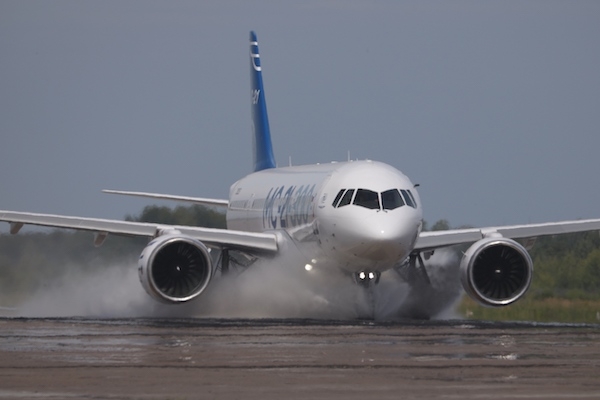
PJSC Irkut Corporation (part of United Aircraft Corporation of Rostec) has successfully completed certification tests of the MC-21-300 airliner under natural icing conditions. The aircraft attained normal performance even when covered with 8 cm thick layer of ice. This fully complies with Russian and European aviation standards: according to certification rules, performance characteristics must be maintained with a layer of ice 7.6 cm thick.
The plane made 14 test flights lasting between 3 to 5 hours over the coast of the White Sea, the Pechora Bay of the Barents Sea, south of Novaya Zemlya, as well as in the region of the Subpolar Urals. The plane returned today from the Arkhangelsk airport to the Ramenskoye airfield in Zhukovsky.
The spring conditions in White and Barents Seas create multilayered clouds, constant precipitation and sharp changes in pressure that cause constant icing hazards on aircraft. The main danger caused by ice is the distortion of the delicate shape of the wing and other surfaces of the aircraft, as a result of which its flight performance can significantly deteriorate.
MC-21-300 test flights from Arkhangelsk airport were organized in several stages. During the first stage, the aircraft crew used meteorological service data to search for clouds that would cause icing comparable to the conditions for the aircraft certification. When flying in these clouds, the crew used special instruments to monitor the formation of ice on the surfaces of the aircraft. Upon reaching the required ice thickness, the plane flew to a given altitude, at which its behavior under natural icing conditions could be observed. The thickness of the ice layer increased from flight to flight.
In addition to the stability and controllability of the aircraft, the operation of the anti-icing systems of the MC-21-300 aircraft was also tested. According to the current regulations, the tests also have to confirm the ability of the aircraft to continue flying even when the anti-icing system is inoperative. Several separate aircraft systems were tested under these conditions, in particular, external lighting equipment, radio communication equipment and landing gear.
The flights were performed by the Irkut Corporation crew consisting of test pilot Vasily Sevastyanov, test navigator Sergei Kudryashov, test engineers Nikolai Fonurin and Alexander Popov. The crew also included Nikolai Grigoriev, a pilot working with the certification process of the State Research Institute of Civil Aviation.
Afterwards, representatives from authorized certification centers and the Aviation Register of the Russia took part in processing the materials received during the flights.
Merlin received a Part 146 Aircraft Design Organization certificate from the Civil Aviation Authority of New Zealand. Merlin's own engineers holding delegation authority can now approve...
RECARO Aircraft Seating introduces the R4, its new generation of premium‑class seating. Building on the legacy of the PL3530 launched in 2015, the R4 integrates advanced ergonomics, upgraded comfort e...
easyJet revealed that since first launching its initiative to recruit older workers in 2022, the number of cabin crew over the age of 50 has now more than doubled (up 127%) at the airline, with over 6...
United announced the largest international network expansion in company history with 10 new international cities and three new routes across Europe and Asia, and debuted the newest international aircr...

