



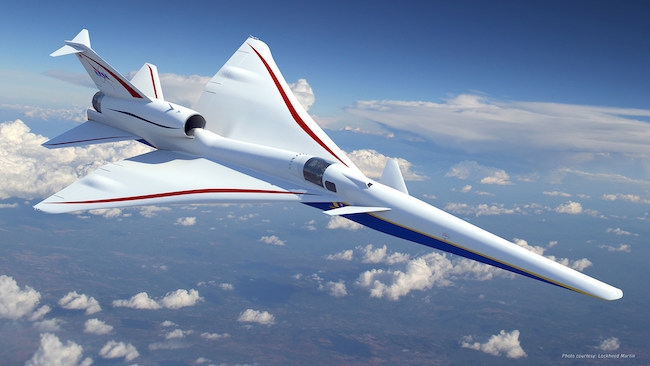
In line with its vision to redefine aerospace, Collins Aerospace has been selected by Lockheed Martin to provide avionics for the new X-59 Quiet Supersonic Technology (QueSST) aircraft. The X-59 is being developed by Lockheed Martin for NASA to collect data that could make supersonic commercial travel over land possible through low sonic boom technology. Collins Aerospace is a business unit of United Technologies Corp.
Collins will provide developmental engineering support to tailor its Pro Line Fusion avionics to the specific requirements of the X-59. By jointly developing software applications side-by-side, Lockheed Martin will receive an optimized solution which will also include Collins' award-winning touchscreen primary flight displays with tailored multi-function windows, head-up display (HUD) symbology, synthetic vision, ARC-210 communication radios, and a suite of navigation and surveillance equipment. Lockheed Martin will house a System Integration Lab for the Pro Line Fusion avionics at its facility in Palmdale, California.
In addition, Collins will provide a dual multi-spectral enhanced vision system (EVS-3600). In order to achieve supersonic speeds with a low sonic boom signature, the X-59 must have a long and slender shape. This shape also makes a forward-looking window impractical. The EVS-3600 will enable pilots to land in nearly all conditions using advanced visual sensors leveraging long wave, infrared technology.
"Our industry-leading avionics, combined with one of the most advanced EVS cameras in the market, will add to the safety and efficiency of this forward-leaning aircraft," said Dave Schreck, vice president and general manager for Military Avionics and Helicopters at Collins Aerospace. "We look forward to working with Lockheed Martin and NASA to play an integral role in making quiet supersonic travel over land possible for passengers."
The X-59, which is expected to take its first flight in 2021, is designed to create a sound about as loud as a car door closing, instead of a sonic boom. It will be used to collect data on the acceptability of the quiet sonic boom generated by the aircraft, helping NASA establish an acceptable commercial supersonic noise standard to overturn current regulations banning supersonic travel over land.
Volatus Aerospace announced the next phase of its national wildfire response initiative through a strategic partnership with Singular Aircraft, developer of the FlyOx 1 multi-mission heavy-lift autono...
Honda Aircraft Company announced first delivery of HondaJet Elite II in Brazil, marking a significant milestone in the company’s continued commitment to general aviation in South America. The de...
ALTEA released a comprehensive Business Jet Pre-Sale Housekeeping Guide, designed to help owners address essential legal, technical, financial, and design details before bringing an aircraft to the ma...
EVA Air will begin a new nonstop service from Taipei to Delhi on December 1, with bookings now open on EVA Air's website or travel agencies. Operating five flights per week with Airbus A330-300 ai...

