



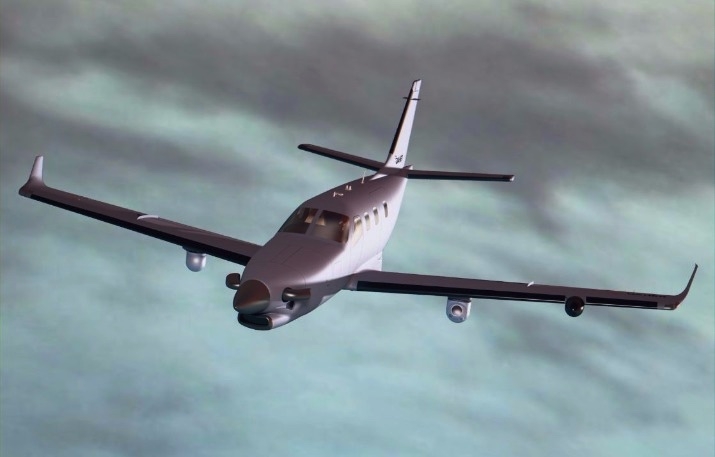
Daher today announced a new configuration of its TBM 910 and TBM 930 high-speed single-turboprop aircraft as efficient and capable platforms for intelligence, surveillance and reconnaissance (ISR) missions.
The enhanced ISR capability for Daher’s in-production TBM family aircraft was announced at Eurosatory 2018, the international defense and security show being held June 11-15 at the Paris Nord Villepinte exhibition center (Daher booth is K99 in the hall 6).
This new TBM configuration is characterized by underwing hardpoints with electrical connections that enable the aircraft to be equipped with various sensors and large-format cameras. A Daher flight test campaign, followed by the use of a 110-lb. (50 kg.) ultra-high definition camera for photo-taking trials, validated that the TBM retains its handling qualities and flight envelope performance in the ISR configuration.
In addition to photographic duties, the TBM 910/TBM 930 ISR version can perform surveillance missions with a multi-sensor optronic retractable turret, as well as Synthetic Aperture Radar/Ground Moving Target Indicator radar (SAR/GMTI), a communication interception system, and secure transmission means. In the cabin, a quick-change console can be mounted behind the pilot for an operator in charge of the various systems and tactical situation monitoring.
"The new TBM ISR version brings a fast, all-weather airborne platform to the market for surveillance operations and aerial photography, with a very competitive cost-performance ratio compared to existing solutions,” commented Nicolas Chabbert, director of the Daher Airplane Business Unit. “As a result, we are now offering the TBM ISR as an alternative – or complement – to medium-altitude, long-endurance (MALE) unmanned aerial vehicles and to heavier aircraft in a platform that is rapid and efficient to deploy, with limited logistics requirements.”
In the ISR configuration, the TBM 910 and TBM 930 can fulfill a wide range of defense, security, medical evacuation and transport missions, benefitting from the autonomy of more than six hours on a surveillance mission, and the ability to be reconfigured rapidly for its various duties.
Advantages of the TBM 910 and TBM 930 ISR include:
- Higher speed range for sensitive missions and rapid travel time to the mission zone,
- Reduced external noise for discretion,
- Reduced takeoff and landing distances, enabling operations from 2,455-ft. (750- meter) runways,
- Sufficient power generation allowing a full range of mission equipment to be integrated,
- A modern human-machine interface (main functions available on control yoke, single power lever), allowing the crew to fly comfortably during long-duration missions.

The International Aircraft Dealers Association (IADA) has released its 2026-2027 Current Market Portrait & Forecast, offering an in-depth analysis of the global preowned business av...
PAL-V has signed a Memorandum of Understanding with AVION, a specialist in advanced flight training devices, and FLYVE, a developer of FlyDrive ecosystems for professional and government operator...
Rising production rates and the launch of new aircraft programs are driving increased demand for manufacturing capacity across the aerospace industry. To support this growth, FACC plans to i...
Tecnam has announced a landmark strategic partnership aimed at accelerating the growth of its P2012 aircraft family across the United States. Under the agreement, Finnoff has been appointed the exclus...

