



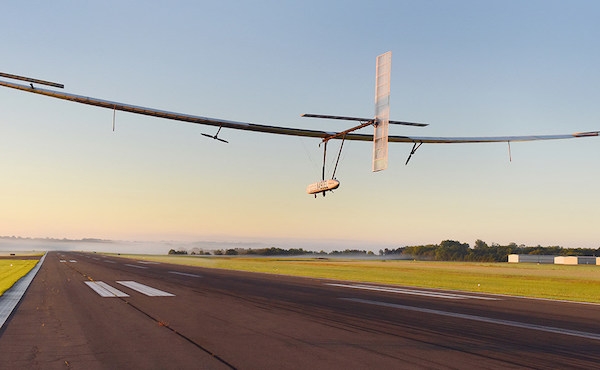
Electra has completed the first flight of a solar-battery hybrid electric research aircraft. This 90-foot wingspan unmanned aircraft system made its first flight from Manassas Regional Airport, Virginia on September 9, 2022, and is the first airplane to emerge from Electra's new development facility there.
The new plane, named Dawn One, is part of the Stratospheric Airborne Climate Observatory System (SACOS) program. SACOS is being developed under the leadership of Professor James G. Anderson at Harvard University. The project is supported by a contract from the NASA and by the Weld Foundation for Scientific and Environmental Development.
Professor Anderson said: "SACOS is designed to innovatively address a broad range of scientific missions and serve as a climate observing system that will herald a new era in the quantitative dissection of the physics, chemistry, and biology controlling critical climate systems. Following the lead of the new National Academy of Sciences report Global Change Research Needs and Opportunities for 2022-2031, SACOS promises to dramatically expand our national climate research capabilities."
"The high-spatial resolution observations from SACOS will provide, for the first time, quantitative forecasts of risk associated with rapidly expanding wildfires, the increasing rate of sea level rise, the intensification of severe storms, and global shifts in arid regions that trigger water shortages. Moreover, these quantitative forecasts of risk will, in turn, establish the essential intellectual links directly coupling irreversible changes in the climate structure to economics, public policy, and associated societal instability," Professor Anderson explained.
The Dawn One project originated at the Massachusetts Institute of Technology (MIT) led by Professors John Hansmanand Mark Drela. Detailed design, construction, and testing of the aircraft were led by Electra. This solar-battery aircraft is part of Electra's ongoing development of reduced and zero-carbon aircraft propulsion technologies, which also include turbine-electric and hydrogen fuel cell-based hybrid systems.
The SACOS flight is part of the public celebration of the 2021 Dreyfus Prize in Chemical Sciences, to be presented to Professor Anderson on September 29, 2022 at Harvard. JP (James) Stewart of Electra and Annick DeWald of MIT led the aircraft team that included researchers and students from MIT, Harvard, Virginia Tech, Penn State, Stanford, Tuskegee, Embry Riddle, University of Michigan, San Diego State, and The University of Texas at El Paso.
Rotortrade, the global helicopter dealership, has confirmed its participation in EUROPEAN ROTORS 2026, which will take place at EUREXPO Lyon, France. Marking its first edition in France, EUROPEAN...
At AERO 2027, taking place from 14 to 17 April 2027, gliding will once again take centre stage with the dedicated AERO Gliding Expo exhibition area. As part of Europe’s leading trade show for ai...
Rising production rates and the launch of new aircraft programs are driving increased demand for manufacturing capacity across the aerospace industry. To support this growth, FACC plans to i...
PAL-V has signed a Memorandum of Understanding with AVION, a specialist in advanced flight training devices, and FLYVE, a developer of FlyDrive ecosystems for professional and government operator...

