



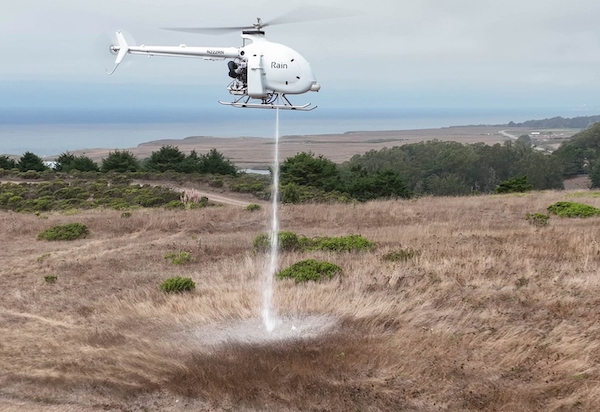
Rain announced an oversubscribed seed round, closing $9.7 million in financing earlier this year to provide fire agencies the ability to contain wildfires before they grow out of control with prepositioned autonomous aircraft. DBL Partners led the round, with participation from Volo Earth Ventures, Kapor Capital and Convective Capital. Other investors include Immad Akhund, Brian Bjelde, Steve Blank, John and Patrick Collison, Edward Fenster, Dylan Field, Nat Friedman, Daniel Gross, Geoff Ralston, and Blake Scholl. The funding will be used to advance pilot projects in the United States.
Founded in 2019, Rain draws on fire agency insights and personal experience with extreme wildfire to create the first autonomous rapid wildfire suppression system, addressing the urgent need to scale, expedite and modernize response to the growing number of wildfires.
Maxwell Brodie, Rain CEO and co-founder, commented: “As I write this, my hometown is burning. Paradise, Greenville, Lytton, Lahaina and too many other towns have burned to the ground. Every year catastrophic wildfires claim lives, destroy entire communities, and diminish the carbon reduction efforts of nations and states. Rain’s technology enables a wildfire response time so fast that we can actually stop fires before they have a chance to grow out of control. Early response timing, like any emergency, can make all the difference in a successful outcome.”
Rain adapts autonomous aircraft with a wildfire intelligence system to rapidly perceive, understand and suppress early-stage wildfire ignitions, capabilities not yet seen in wildfire technology. This technology enables the prepositioning of firefighting aircraft in high wildfire risk areas and works with existing wildfire detection systems that remotely dispatch Rain-equipped aircraft as soon as ignition is detected, deploying the aircraft within seconds and reaching a nascent fire within minutes. New research shows that a 15 minute improvement to wildfire response time could generate an economic benefit of $3.5-8.2 billion dollars in California alone. In the U.S. total annualized costs associated with wildfire average $348 billion per year. With extreme wildfires estimated to rise 14% by 2030, the collective problem is only getting worse.
Nancy Pfund, Founder and Managing Partner, DBL Partners and board member at Rain, said: “Catastrophic wildfires are a climate flywheel we cannot ignore. 18% of total global fossil fuel CO2 emissions were emitted by wildfires in 2021. The CO2 emissions from the 2023 Canadian wildfires are approaching three times the annual emissions of the state of California. Working with firefighting professionals, land owners and managers, conservation experts, residents, government officials, insurers, utilities and other constituencies, Rain can help to catalyze a new, more effective approach to preventing the spread of unwanted wildfires. Rain’s 21st century technology not only promises to drive better wildfire outcomes, it will also help to create important new markets, and jobs. As an impact venture capital firm, we at DBL see Rain’s mission as the epitome of Double Bottom Line Investing.”
Kareem Dabbagh, Co-Founder & Managing Partner, VoLo Earth Ventures, steted: ”Forests have reached a critical tipping point, releasing more carbon due to wildfire than they are able to store. Rain's platform, as the future of autonomous aircraft for wildfire protection, will save billions of dollars in expense and allow insurers the ability to improve their wildfire risk adoption, protecting property, electric grids, and human and planetary health.” So far in 2023, both the White House and Congress have authored policy guidance encouraging or requiring fire agencies to develop plans to adopt autonomous aircraft for rapid wildfire suppression.
John Collison, President of Stripe, said: “The steady rise of catastrophic wildfires is plain to see. Aerial firefighting is one of the most important use cases for autonomous flight, where Rain’s technological leaps can shorten response times, keep pilots out of harm’s way, and increase total fire suppression capabilities at a time when we sorely need them. Bring on the firefighter drones!”
As the first aviation company in Kansas to introduce state-registered youth apprenticeships through the Kansas Office of Apprenticeships, Textron Aviation is taking a leading role in workforce develop...
Etihad Airways has signed an interline agreement with Nigerian airline Ibom Air, enabling travellers to connect seamlessly beyond Lagos and Accra to five destinations across Nigeria on a single t...
Rising production rates and the launch of new aircraft programs are driving increased demand for manufacturing capacity across the aerospace industry. To support this growth, FACC plans to i...
UH-60 Black Hawk helicopters operated by Helicopter Alliance played a vital role in combating wildfires across Central and Southern Europe during the aerial firefighting season that has now concluded....

