




The Development of Sustainable Aero-Propulsion Systems - an urgent issue which need to be developped by all means. As the global air traffic is growing and will continue to growi for about 5% each year, all aeronautical industry player should come together with scientist in order to find most effective solutions. Thanks to the Safran Industrial Research Chair on the Development of Sustainable Aero-Propulsion Systems, inaugurated on December 5th at École de technologie supérieure, Professor Garnier will work with Safran, a major aviation industry supplier, to design cleaner aircraft engines.
"To create cleaner engines, we must fully understand the physical and chemical processes that result in the formation of polluting emissions, both in the engine components and the propulsive jet," explained Professor Garnier. His research team will develop models to better identify the dynamics of aerosols and their gaseous precursors. Experimental data will be used to calibrate the models for the best possible representation of reality.
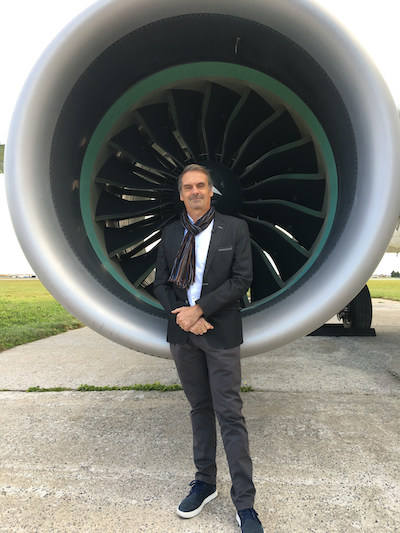
"Every two seconds, somewhere in the world, an aircraft equipped with a Safran engine takes off. Moreover, though civil aviation has greatly improved its energy efficiency and reduced its effects on air quality over the past few decades, the growth in air traffic is putting pressure on the environment. Faced with this reality, Safran is exploring all possible avenues toward reducing the environmental footprint of the aeronautical industry, and our participation in this Chair will help us achieve that goal," said Sylvain Boisvert, General Manager Canada of Safran Engineering.
A transitional certification standard currently exists for non-volatile particles – smoke emissions – which are found in the vicinity of airports, but it does not apply to volatile particle emissions (vPM). This will soon change: two new international standards will come into effect in 2020 – one for vPM emissions and another related to CO2 emissions. Research work led by François Garnier will help OEMs adapt to the new standards.
The world aerospace industry, through the International Civil Aviation Organization (ICAO), has committed to reducing its environmental footprint. Several research projects directed by ÉTS aeronautics researchers focus on various fronts identified by ICAO, such as biofuels, the design of more fuel-efficient engines and of electric and hybrid propulsion systems, reduction of aircraft mass and improved management of the various phases of flight.
Tecnam introduces the P2008JC NG to the United States market, bringing flight schools a certified, next-generation training aircraft designed to dramatically reduce operating costs while maximizing fl...
Emirates has officially inaugurated services to Helsinki, marking a significant milestone in connectivity between Finland and the United Arab Emirates. The new daily route is the only year-r...
For the fourth consecutive year, Corsair is reaffirming its commitment to the fight against breast cancer by partnering with the association "Les Hôtesses de l’Air cont...
Dutch flag carrier KLM, part of the Air France-KLM Group, has welcomed its first Airbus A350-900, marking a significant step in the airline’s long-haul fleet modernization strategy. The arrival...

