



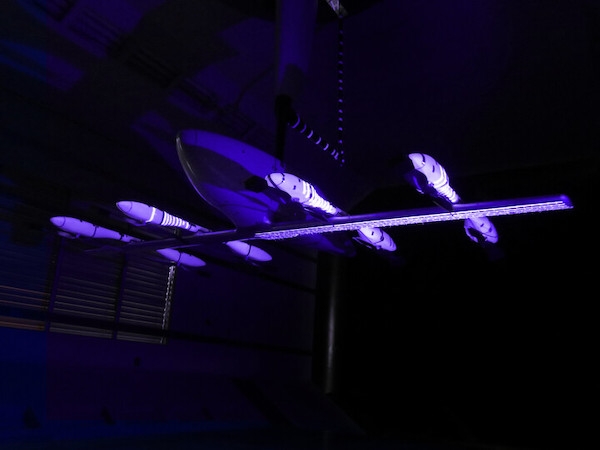
Eve recently completed wind tunnel testing of its eVTOL vehicle. The testing, which was conducted at a wind tunnel near Lucerne, Switzerland, utilized a scale model of Eve’s eVTOL which is projected to enter service in 2026. Wind tunnel testing is an important engineering tool used in the development of an aircraft. The testing allows engineers to monitor the flow of air over and around the vehicle and each of its individual parts. It is also used to measure the aerodynamic forces and moments acting on the vehicle, allowing the team to evaluate the vehicle’s lift, efficiency, flying qualities and performance.
Luiz Valentini, chief technology officer at Eve Air Mobility commented: “The completion of wind tunnel testing is an important engineering milestone as we continue the development of our eVTOL. The information we obtained during this phase of development has helped us further refine the technical solutions of our eVTOL before committing to production tooling and conforming prototypes. Our goal is to design, produce and certify an aerodynamic and efficient eVTOL that will be used for a variety of urban air mobility missions.”
The main objective of the test was to investigate and validate how components including fuselage, rotors, wing, tail and other surfaces would perform in flight. Wind tunnel testing provides a unique view of aerodynamic behavior of complex geometry and provides a higher level of validation of design characteristics. The tests are part of an effort to acquire experimental data to validate production solutions, development tools and models which also includes other test articles such as fixed and moving rigs, flying vehicles and other wind tunnel tests.
Eve engineering team will use the data gathered through wind tunnel testing to continue to develop the eVTOL’s control laws leading to optimal performance and passenger comfort. Eve eVTOL is 100% electric and has a range of 60 miles (100 kilometers) allowing it to complete a variety of urban air mobility missions. Its human-centered design ensures the safety, accessibility and comfort of passengers, the pilot and the community by minimizing noise. The aircraft features a lift + cruise configuration with dedicated rotors for vertical flight and fixed wings to fly on cruise, with no components required to change position during flight. It will be piloted at launch, but ready for autonomous operations in the future.
TRU Simulation + Training Inc. will showcase its Veris Virtual Reality Flight Training Device (FTD) for the Cessna Skyhawk at NBAA-BACE 2026, marking the simulator's first appearance at the indust...
Rising production rates and the launch of new aircraft programs are driving increased demand for manufacturing capacity across the aerospace industry. To support this growth, FACC plans to i...
Azerbaijan Airlines (AZAL), part of AZCON Holding, has taken delivery of another Airbus A321neo, increasing its fleet to 31 aircraft as the carrier continues its long-term modernisation strategy. The...
Emirates has officially inaugurated services to Helsinki, marking a significant milestone in connectivity between Finland and the United Arab Emirates. The new daily route is the only year-r...

