



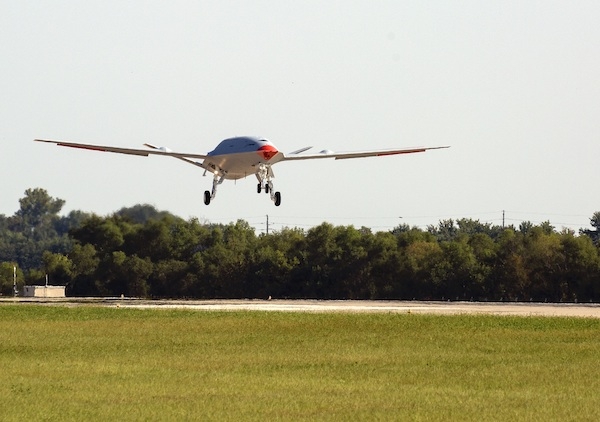
An unmanned aerial refueler? You think it is possible? The answer is positive! The first test flight of the MQ-25™ unmanned aerial refueler is successfully completed by Boeing and U.S. Navy.
The MQ-25 test asset, known as T1, completed the autonomous two-hour flight under the direction of Boeing test pilots operating from a ground control station at MidAmerica St. Louis Airport in Mascoutah, Ill., where the test program is based. The aircraft completed an autonomous taxi and takeoff and then flew a pre-determined route to validate the aircraft’s basic flight functions and operations with the ground control station.
“Seeing MQ-25 in the sky is a testament to our Boeing and Navy team working the technology, systems and processes that are helping get MQ-25 to the carrier,” said Boeing MQ-25 Program Director Dave Bujold. “This aircraft and its flight test program ensures we’re delivering the MQ-25 to the carrier fleet with the safety, reliability and capability the U.S. Navy needs to conduct its vital mission.”
The Boeing-owned test asset is a predecessor to the engineering development model (EDM) aircraft and is being used for early learning and discovery to meet the goals of the U.S. Navy’s accelerated acquisition program. Boeing will produce four EDM MQ-25 air vehicles for the U.S. Navy under an $805 million contract awarded in August 2018.
The MQ-25 will provide the Navy with a much-needed carrier-based unmanned aerial refueling capability. It will allow for better use of the combat strike fighters currently performing the tanking role and will extend the range of the carrier air wing.
“Today’s flight is an exciting and significant milestone for our program and the Navy,” said the Navy’s Unmanned Carrier Aviation (PMA-268) Program Manager Capt. Chad Reed. “The flight of this test asset two years before our first MQ-25 arrives represents the first big step in a series of early learning opportunities that are helping us progress toward delivery of a game-changing capability for the carrier air wing and strike group commanders.”
T1 received its experimental airworthiness certificate from the FAA in September, verifying that the air vehicle meets the agency’s requirements for safe flight. Testing will continue with T1 to further early learning and discovery that advances major systems and software development.
The International Aircraft Dealers Association (IADA) has released its 2026-2027 Current Market Portrait & Forecast, offering an in-depth analysis of the global preowned business av...
Tecnam introduces the P2008JC NG to the United States market, bringing flight schools a certified, next-generation training aircraft designed to dramatically reduce operating costs while maximizing fl...
Emirates has officially inaugurated services to Helsinki, marking a significant milestone in connectivity between Finland and the United Arab Emirates. The new daily route is the only year-r...
For the fourth consecutive year, Corsair is reaffirming its commitment to the fight against breast cancer by partnering with the association "Les Hôtesses de l’Air cont...

