



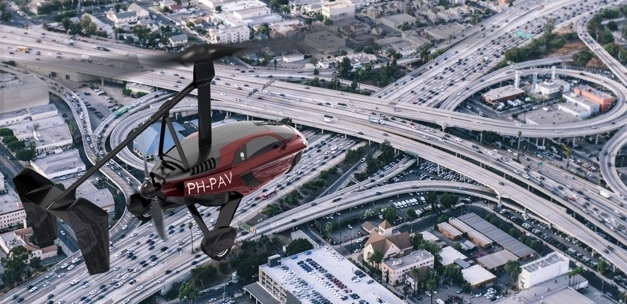
The goal is quite clear and ambitious: a market introduction of the flying car within 10 years. There is a road to make. On the 8th of April 2019,a MoU for a mutual cooperation to develop an autonomous eVTOL flying car was signed between PAL-V and Royal Netherlands Aerospace Centre.
Autonomous flying with an eVTOL (electrical Vertical Take-Off and Landing) should be made possible by Royal NLR and PAL-V within 10 years. At the moment PAL-V is finalizing the development of the PAL-V Liberty, world’s first commercial flying car that will enter the market in 2020. The PAL-V Liberty is intended for the City-to-City mobility market. With the signing of this MoU, both parties express their vision and reinforce their collaboration to improve and elevate the Urban Air Mobility market with an eVTOL flying car. Vice President Aerospace Vehicles Collin Beers of NLR: “NLR has a strong focus on sustainability in the aviation industry. In order to do this NLR is involved in various projects to support Dutch and international partners. One of these projects will be the development of an eVTOL for Urban Air Mobility to support aviation industry worldwide.”
As Robert Dingemanse, CEO of PAL-V, continues: “This MoU is a next step in growing our company. In 2020 PAL-V will deliver the first series of the
PAL-V Liberty for the City-to-City mobility market. Making it possible to fly outside of cities and drive within. With this MoU PAL-V makes another step to develop a flying car for the Urban Air Mobility market, where people can fly electrically without a pilot from one point of the city to another. A number of the technologies that we will develop together in this project will also be used for our current model, the PAL-V Liberty.”
“The main focus of PAL-V is personal air mobility which is a high potential market for the upcoming decennia”, explains Dingemanse. “In order to successfully deliver an electric autonomous airworthy prototype for urban air mobility we will take all the stakeholders into account: creator, operator and regulator. PAL-V and NLR will therefore also look into the ’flying car taxi service’. This will allow people to use the PAL-V as a shared mobility platform instead of owning a flying car themselves, which will further reduce the traffic congestion in cities. The same approach we used during the realisation of the PAL-V Liberty. The know-how that we created until now is a solid foundation of this next project together with NLR.”

British Airways has unveiled the next phase of its Heathrow lounge transformation programme, marking the beginning of a significant investment aimed at modernising every lounge across the airport in t...
flyadeal, the fast-growing low-cost carrier of Saudia Group and one of the GCC's largest budget airlines, has expanded its presence in India with the launch of non-stop flights between Riyadh and...
Tecnam has announced a landmark strategic partnership aimed at accelerating the growth of its P2012 aircraft family across the United States. Under the agreement, Finnoff has been appointed the exclus...
Boeing and Ethiopian Airlines have announced a new cargo fleet expansion agreement, with the African carrier ordering eight 777-8 Freighters and two additional 777 Freighters. The investment will enab...

