



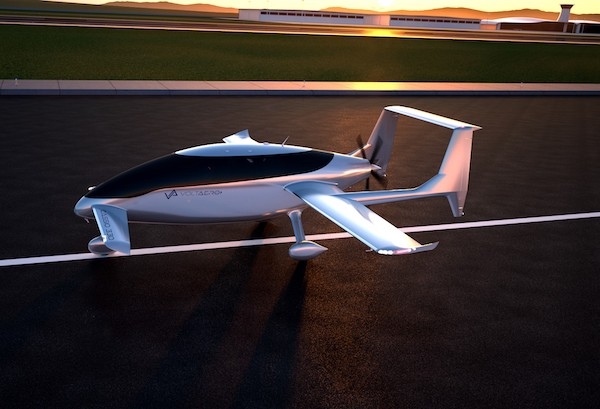
VoltAero funding for the development of its Cassio 330 electric-hybrid aircraft has further increased with a €5.6 million grant from the French government via BPI France. The financing was made available through the “France 2030” investment plan, which was established by the French government with the goal of sustainably transforming key sectors of the country’s economy – including aeronautics. Cassio 330 is the first of three versions in VoltAero electric-hybrid aircraft family that share a high degree of modularity and commonality. The family’s design is based on VoltAero’s clean-sheet configuration with a sleek, aerodynamically-optimized aircraft.
Jean Botti, VoltAero’s CEO and Chief Technical Officer, commented: “This grant is another important vote of confidence in VoltAero and our vision to develop the unique family of Cassio electric-hybrid general aviation airplanes for safe, quiet, efficient and eco-friendly flight. It contributes to the Cassio 330’s development, certification and production.”
The Cassio family will be a highly capable and reliable product line for regional commercial operators, air taxi/charter companies, private owners, as well as in utility-category service for cargo, postal delivery and Medevac applications. By integrating VoltAero’s patented electric-hybrid propulsion system into the purpose-designed airplane, Cassio will deliver an order of magnitude higher performance as compared to the current competition, and provide significantly lower operational costs.
First version to enter service will be the Cassio 330, with five seats and power delivered by the 330-kilowatt electric-hybrid propulsion system. VoltAero’s follow-on six-seat Cassio 480 will have an electric-hybrid propulsion power of 480 kilowatts, while the Cassio 600 is sized at a 12-seat capacity with electric-hybrid propulsion power of 600 kilowatts.
The VoltAero propulsion concept is unique: Cassio aircraft will utilize electric motors in the aft fuselage-mounted propulsion system for all-electric power during taxi, takeoff, primary flight (if the distance traveled is less than 150 km.), and landing. The hybrid feature – with an internal combustion engine – comes into play as a range extender, recharging the batteries while in flight. Additionally, this hybrid element serves as a backup in the event of a problem with the electric propulsion, ensuring true fail-safe functionality. In addition, it has the capability to use multiple fuels.

Archer Aviation has unveiled plans to develop three air taxi networks across Austin, Dallas-Fort Worth and Houston, aiming to improve connectivity between major airports, business centers and key regi...
The U.S. Federal Aviation Administration has certified the Boeing 737-10, the newest and largest member of the 737 MAX family, paving the way for Boeing [NYSE: BA] to begin customer deliveri...
Lufthansa Technik Engine Services (LTES) is significantly expanding its engine maintenance capabilities in Tulsa, Oklahoma, nearly doubling its operational capacity as part of its growth strategy acro...
Asco, a subsidiary of Montana Aerospace AG, achieves significant technological milestone in the development of a hybrid multi-material Rear Secondary Structure for Airbus. Montana Aerospace,...

