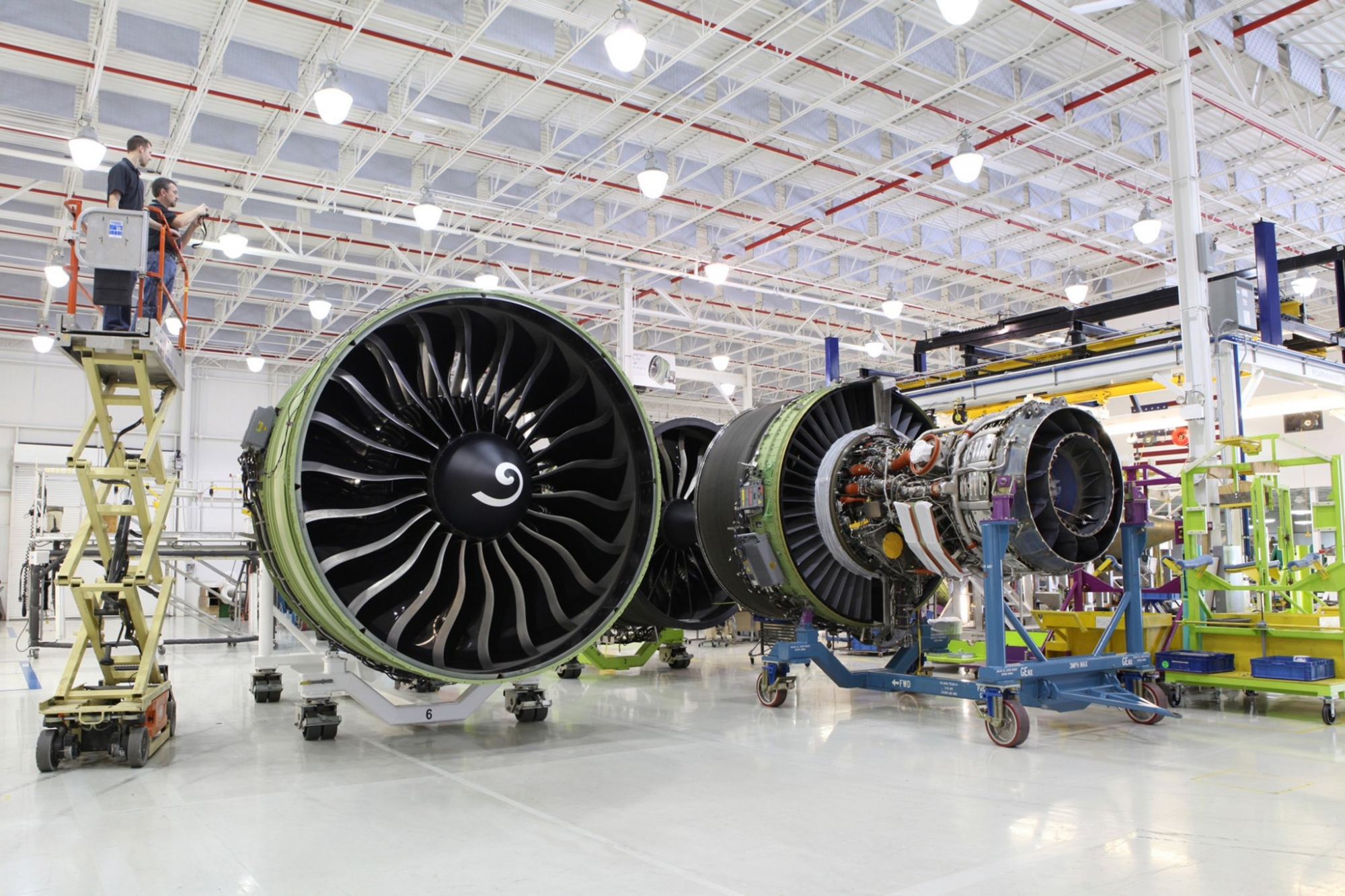
Ceramic matrix composites (CMC) are a critical pathway on GE Aviation’s technology roadmap, and recent tests on a GEnx demonstrator engine with GE9X CMC components in the combustor and turbine yielded impressive results for the ultra-lightweight, heat-resistant material.
The use of CMCs in the hot section of GE jet engines is a breakthrough for the jet propulsion industry. The demonstrator engine testing is part of the technology maturation program for the GE9X engine that will power the Boeing 777X. The GEnx engine contained CMC components in the combustor and high pressure turbine (HPT).
“The GEnx demonstrator engine accumulated 2,800 endurance cycles at a GE test stand in Peebles, Ohio and an Avio Aero test cell in Naples, Italy,” said Bill Millhaem, general manager of the GE90/GE9X engine programs at GE Aviation. “When the engine was torn down, the CMC components were in pristine condition, further confirming the unique characteristics of CMCs.”
CMCs comprise silicon carbide (SiC) ceramic fibers in a SiC matrix, enhanced by proprietary coatings. For more than 20 years, scientists at GE’s Global Research Centers (GRC) and GE’s industrial businesses worked to develop CMCs for commercial applications.
With one-third the density of metal alloys, lightweight CMC components reduce an engine’s overall weight for improved fuel efficiency. CMC’s high-temperature properties greatly enhance engine performance, durability, and fuel economy. Since CMCs are far more heat resistant than metal alloys, they require less cooling air in the engine’s hot section. This air instead can be used in the engine flow path, enabling it to run more efficiently.
GE’s use of CMCs in commercial jet engines is well underway. CFM International*’s best-selling LEAP engine is the first commercial jet engine to use CMC shrouds in the HPT. The GE9X engine expands CMC use to the inner and outer combustor liners, HPT stage 1 and stage 2 nozzles and stage 1 shrouds.
The GEnx CMC demonstrator engine also validated non-CMC parts for the GE9X including the new 3D additive manufactured lightweight low-pressure turbine titanium aluminide (TiAl) blades produced at Avio Aero and the next-generation HPT stage 1 blades with advance cooling technology. The next-generation HPTblades utilize a proprietary process invented at GRC and industrialized at GE Aviation’s Cores & Castings facility in Dayton, OH. This novel process employs the most efficient cooling circuits ever produced, which result in significant fuel efficiency improvement over historical designs.
CMC testing for the GE9X will continue. The GEnx demonstrator engine will be rebuilt and run with the same combustor liners, HPT stage 1 shrouds and HPT stage 2 nozzles, LPT TiAl blades and the next-gen HPTblades along with the addition of HPT stage 1 nozzles. A GE9X core with CMC components in the combustor and HPT will begin testing next month.
To learn how GE manufactures CMCs click HERE. To learn more about the 3D additive process at Avio Aero click HERE.
The GE9X engine will be in the 100,000 pound thrust class. Key features include a 134-inch diameter composite fan case and 16 composite fan blades; a next-generation 27:1 pressure-ratio 11-stage high-pressure compressor; a third-generation TAPS III combustor for high efficiency and low emissions; and CMCmaterial in the combustor and turbine. The first engine will test in 2016 with flight-testing on GE’s flying testbed anticipated in 2017. Engine certification is scheduled for 2018.
Almost 700 GE9X engines have been ordered by customers since it was launched on the Boeing 777X aircraft.
IHI Corporation, Snecma and Techspace Aero (Safran), and MTU Aero Engines AG are participants in the GE9X engine program.
Gol Airlines continues to expand its South American reach, leveraging its Brazilian network to open new travel possibilities. European passengers can now access southern Argentina through São P...
As the 10th edition of the Riga Aviation Forum was getting ready to open, 50SkyShades — a long‑standing Media Partner of the event — took the opportunity to sit down with Zigmars Vestfals,...
Electra and The Atlas Group today announced a landmark airframe agreement for the EL9 Ultra‑Short aircraft, uniting Electra’s next‑generation design with Atlas’s established aerospace manu...
KVE by Daher is marking its 30th anniversary with the inauguration of a significant expansion of its production facility in The Hague — a development that signals the start of a new acceleration...