



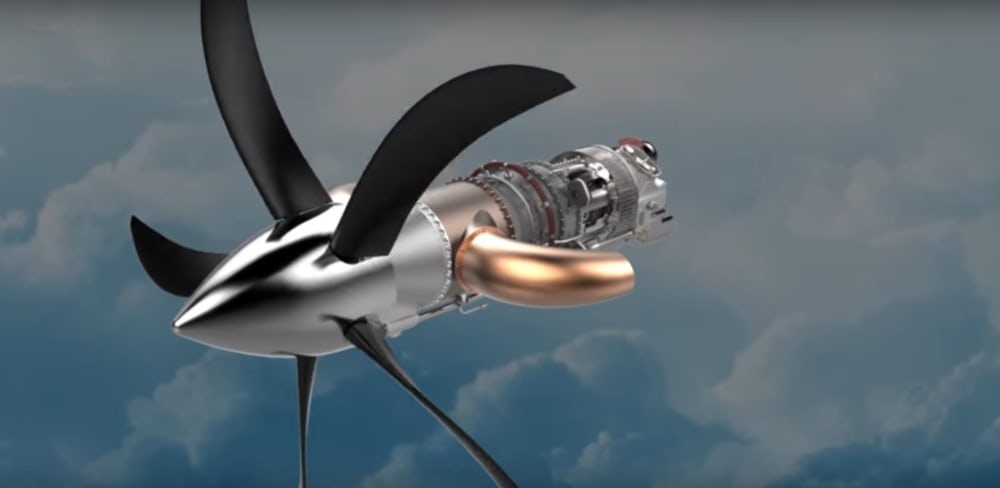
3D printing has come a long way since the certification of a single printed part for aircraft was big news. General Electric Aviation has gone considerably further in the development of its Advanced Turboprop (ATP) for the Cessna Denali single-engine aircraft. The company has completed testing of a demonstrator engine on which the ATP will be based that is made from more than 35 percent 3D-printed parts. According to GE this has resulted in a 5 percent weight savings and a 1 percent increase in fuel efficiency.
The ATP will be derived from technology demonstrator (called the a-CT7) using components printed at GE Aviation's Additive Development Center (ADC) in Cincinnati, Ohio. Designed, built and tested in 18 months, the a-CT7 sees 900 conventionally made parts reduced to 16 printed parts. This adds up to an engine with 35 percent printed parts, which is a new aerospace record for the fraction of printed parts used.
When completed, the 1,240 bhp ATP itself will have 855 conventional parts reduced to 12 printed parts, which include the sumps, bearing housings, frames, exhaust case, combustor liner, heat exchangers and stationary flowpath component. GE Aviation claims the ATP will use 20 percent less fuel for 10 percent more cruise power compared to similar engines.
The advantage of 3D printing is that engine prototypes can be built much faster. GE Aviation says that the ATP combustor rig tests were completed six months early, with the combustor liners printed in two days. This means that there is less of a need to depend on computer models and allows for faster iterations of the engine to be developed and tested, so the time from initial design to final product is reduced. In addition, the parts used can be of a single, simpler design.
"With subtractive manufactured parts and assemblies, you traditionally use bolts, welds or other interfaces to attach the parts together, which adds weight to the engine," says Gordon Follin, ATP Engineering GM at GE Aviation. "On the ATP, additive reduces weight by eliminating those attaching features while also optimizing design of the parts."
GE Aviation says the first complete ATP engine will begin testing at the end of next year and the later versions will use even more printed parts.
Cirrus Aircraft has broken ground on a new 15,000-square-foot Engine Run-Up Center that will centralize engine testing, fuel calibration and certification activities for the SR Series, Vision Jet and...
MTU Maintenance and Garuda Indonesia have entered into a three-year agreement for the maintenance, repair and overhaul of the airline’s GE90-115B engines, which power its fleet of eight Boeing 7...
Private jet catering requires an understanding of the journey as much as the passengers' preferences. SkyDine Jet Catering explores how flight duration, departure schedules, airport location, and...
Oriens Aviation has appointed Narine Melkumjan as Sales Manager for the Netherlands, strengthening its presence in the Dutch market following its designation as Tecnam’s exclusive dealer in the...

