



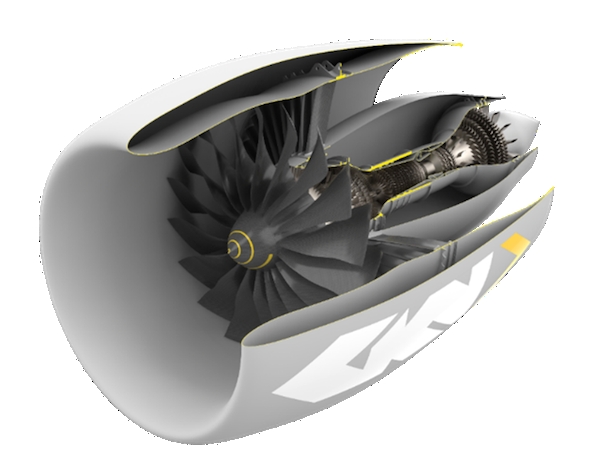
GKN Aerospace is leading a Swedish national collaboration programme called H2JET, aiming to develop technical solutions for three important engine subsystems for H2-propulsion of medium range civil aircraft. The two-year project, which started this month, sees GKN Aerospace collaborate with the Swedish Energy Agency, Chalmers University of Technology, Lund University, KTH Royal Institute of Technology, University West, Research institutes of Sweden (RISE) and Oxeon.
Hydrogen is expected to play a key role in the decarbonisation strategy of aviation as it can power aircraft efficiently, leaving water as the only by-product. Power can be generated by either direct combustion, the focus of H2JET, or by generating onboard electrical power by use of a fuel cell, the focus of GKN Aerospace’s ‘H2GEAR’ program launched earlier this year.
Whilst H2GEAR is exploring a liquid hydrogen propulsion system for sub-regional aircraft, H2JET will explore hydrogen combustion powered turboprop or turbofan engines for the single aisle market for potential entry into service on intra-European routes in 2035.
H2JET puts GKN Aerospace at the heart of the technology developments needed for the future of more sustainable aviation. This would create a new generation of clean air travel, eliminating harmful CO2 emissions.
By validating subsystem- and component technologies for hydrogen combustion engines, H2JET will speed up the development of vital international engine- and aircraft demonstrator programmes, such as Clean Aviation Partnership in the recently launched EU framework programme Horizon Europe.
Europe’s aviation sector has committed to an ambitious plan to reach net zero CO2 emissions, presented earlier this year as Destination 2050. The Destination 2050 roadmap shows a possible pathway that combines new technologies, improved operations, sustainable aviation fuels and economic measures. Hydrogen propulsion technology provides one of the most promising opportunities to decarbonize global aviation.
Henrik Runnemalm, Vice President GKN Aerospace Global Technology Centre in Trollhättan, Sweden said: ”We are excited by this project and with the support from Swedish Energy Agency which makes it possible. We will be able to build on our long experience of hydrogen technology from Europe’s Ariane rocket launcher, as well as our unique capabilities in light-weight design and advanced manufacturing technology to help shape a sustainable future for aviation.”
Sky Travel and parent company Cove Capital Investments, LLC, have unveiled plans to bring nearly 20 business aircraft to market during Q4 2026, reinforcing their commitment to meeting growing demand f...
Emirates has officially inaugurated services to Helsinki, marking a significant milestone in connectivity between Finland and the United Arab Emirates. The new daily route is the only year-r...
PAL-V has signed a Memorandum of Understanding with AVION, a specialist in advanced flight training devices, and FLYVE, a developer of FlyDrive ecosystems for professional and government operator...
Rotortrade, the global helicopter dealership, has confirmed its participation in EUROPEAN ROTORS 2026, which will take place at EUREXPO Lyon, France. Marking its first edition in France, EUROPEAN...

