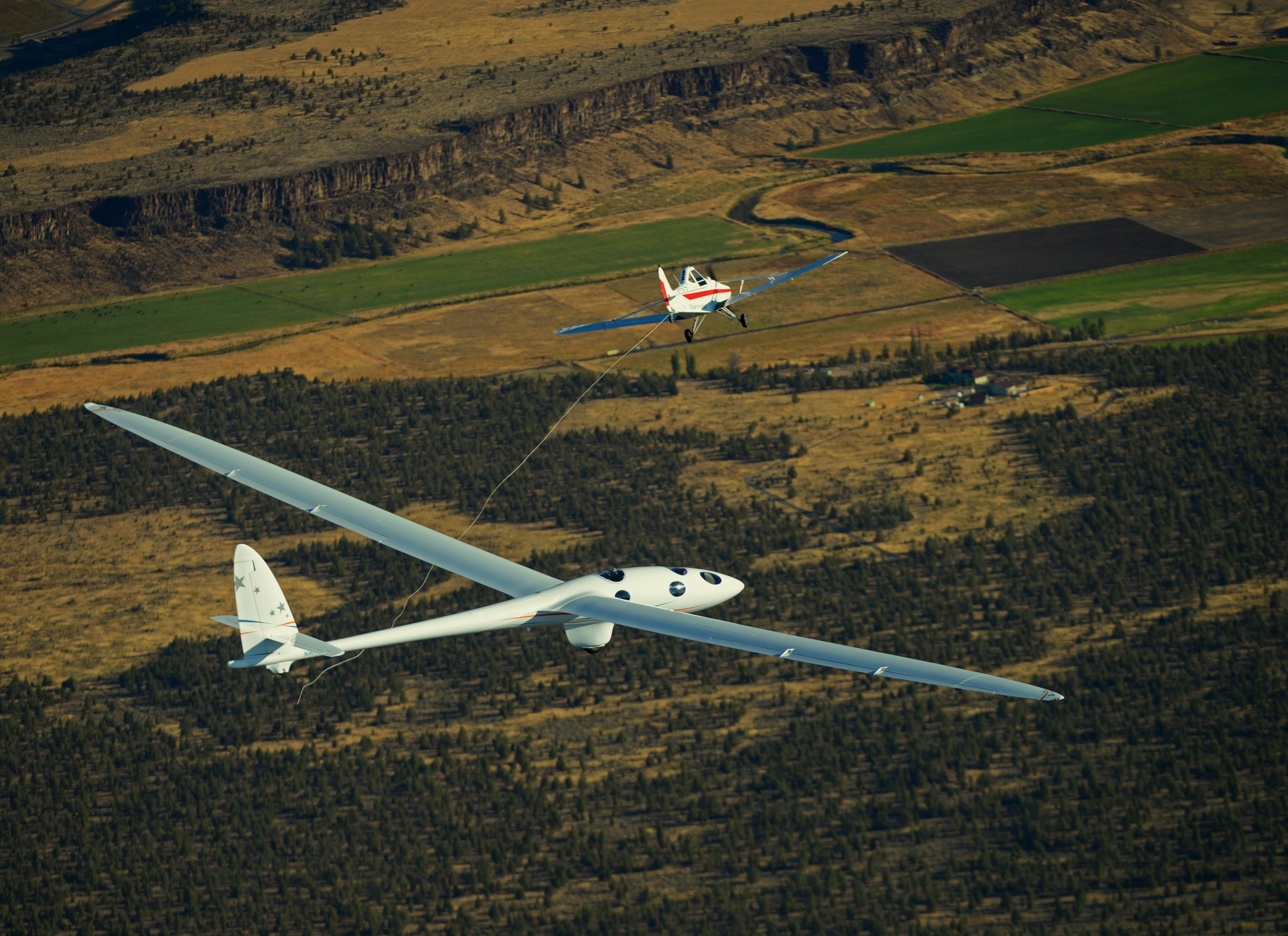
The Perlan 2 glider, the world’s first engineless aircraft designed to reach the edge of space, achieved its successful first flight today in a historic moment about 5,000 feet above Roberts Field, the Redmond Municipal Airport in Oregon.
This was the first test flight of the aircraft, which next year will attempt to set a new world altitude record for any airplane. The goal of this project is to open up a world of new discoveries related to high-altitude flight, climate change and space exploration.
“Airbus Perlan Mission II is a historic endeavour in the truest spirit of aviation’s earliest pioneers,” said Tom Enders, Chief Executive Officer (CEO) of Airbus Group. “The knowledge gained from this project will impact how the world understands and addresses climate change. But it will also help Airbus continue to innovate ways to fly higher, faster and cleaner, on Earth and possibly beyond.”
The Perlan 2 glider was developed by The Perlan Project, a volunteer-run, non-profit endeavour headed by leaders in aerospace and engineering. It is supported by Airbus Group and a group of other sponsors that includes Weather Extreme Ltd., United Technologies and
BRS Aerospace.
Airbus Perlan Mission II is a historic endeavour in the truest spirit of aviation’s earliest pioneers
Tom EndersAirbus Group CEO
We’re extremely excited about the successful first flight of the Perlan 2 glider,”said Ed Warnock, CEO of the Perlan Project. “This marks a major breakthrough in aviation innovation, one that will allow winged exploration of the atmosphere at the edge of space and lead to new discoveries to unravel some of the continuing mysteries of weather, climate change and ozone depletion.”
Jim Payne and Morgan Sandercock piloted today’s flight, which was the first of many for the Airbus Perlan Mission II team as it prepares to soar the aircraft to the edge of space in Argentina in 2016. The Perlan 2 is a pressurized sailplane designed to ride air currents that, in certain mountainous regions near the north and south poles, can reach into the stratosphere. Next year’s flights are expected to reach 90,000 feet, exceeding even the altitudes achieved by the U-2 and the SR-71.
Despite having no engine, the glider’s true flight speed at that altitude will be more than 400 mph and the air density will be less than two percent of what it is at sea level. The crew will breathe pure oxygen provided by a rebreather system, similar to what astronauts use in space.
In addition to its two-person crew, the aircraft carries scientific instruments to provide new insight into climate change and our upper atmosphere. Because it lacks an engine, Perlan 2 can explore the edge of space without polluting the atmosphere it will study, opening up human knowledge on several fronts:
For more information about the Airbus Perlan Mission II, please go to www.perlanproject.com.
Etihad Airways has signed an interline agreement with Nigerian airline Ibom Air, enabling travellers to connect seamlessly beyond Lagos and Accra to five destinations across Nigeria on a single t...
Tecnam introduces the P2008JC NG to the United States market, bringing flight schools a certified, next-generation training aircraft designed to dramatically reduce operating costs while maximizing fl...
The International Aircraft Dealers Association (IADA) has released its 2026-2027 Current Market Portrait & Forecast, offering an in-depth analysis of the global preowned business av...
As the first aviation company in Kansas to introduce state-registered youth apprenticeships through the Kansas Office of Apprenticeships, Textron Aviation is taking a leading role in workforce develop...