



Boeing, the world’s second-largest defense contractor after Lockheed Martin, is primarily known for its design and manufacturing of jet aircraft, rockets and satellites.
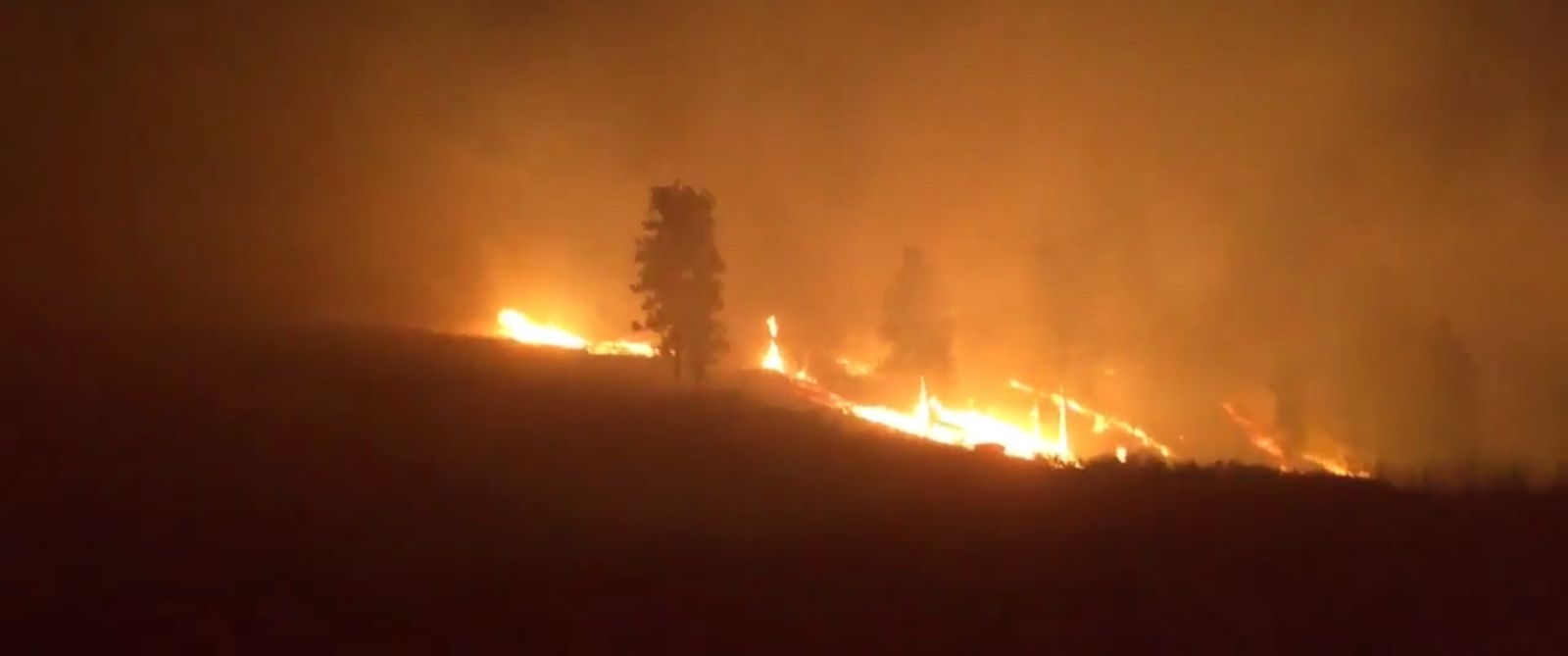
Now the defense giant has signaled interest in developing a new military technology — one that would greatly improve on and speed up techniques for extinguishing wildfires, like the ones currently rampaging through parts of California, Montana, Oregon and Washington State.
Traditionally, Forest Service rangers and firefighters have dropped hundreds of thousands of gallons of chemical fire suppressants and water out of airplanes and helicopters to combat wildfires. Putting out a fire in a relatively confined area of 883 acres could take a day or more under the best of circumstances, according to the National Wildlife Coordinating Group.
But as Defence One reported on Wednesday, Boeing has suggested that firefighters could get the job done faster and more efficiently “by launching salvos of special 155 mm shells from a dozen or more miles away.” Rather than dumping fire suppressant material from planes and helicopters, Boeing’s engineers would pack it into massive shells that would be fired from a field howitzer.
As Defense One explained, the artillery piece might be a BAE Systems M777 or a model manufactured by the Swedish arms merchant Bofors. And the shell would release its load of fire suppressant by virtue of a complex array of gizmos, including a timer, an altimeter, a global positioning device, temperature and pressure sensors and a distance measuring device.

Gene Blevins/Reuters
Boeing filed a patent application for the new shells in 2014 and made its plans public at the end of July. The defense contractor estimates that each shell could deliver as much as six gallons of fire suppressant on a 100-square-foot area, according to Defense One. Boeing engineers assert that steady firing with three-gallon shells could deliver 214,000 gallons of fire suppressant in about six hours. That would be twice as fast as what could be done with a helicopter.
The patent application states that some guns could deliver the fire-retarding material within 15 feet of a target at a 15-mile range, which would be some fancy shooting. But the range and accuracy could vary, depending on the type of shell and artillery gun being used.
As Defense One points out, the proposed new artillery shells may not be the perfect substitute for airplanes and helicopters, but nonetheless “could be a valuable contribution, one that’s desperately needed” as hotter and more ferocious wildfires sweep the West.

Lucy Nicholson/Reuters
Hot, dry and windy conditions “have created a perfect storm for the spread of large wildfires” in several western states, including in California, where they have already destroyed 135 square miles of forest and sent tens of thousands of people fleeing their homes, according to the Associated Press. A total of 26 active fires have burned more than 415,000 acres in eight western states.
Boeing patent application notes that the external surface of the shell would be made of an environmentally safe metal — one that “decomposes in nature in less than ten years or is inert and is not harmful to the environment without decomposition.” The filing also claims that the fragments of the exploded shell would be environmentally friendly.
Even so, Boeing’s novel fire-fighting proposal doesn’t necessarily address another long-standing environmental controversy over the use of fire suppressant materials that contain the toxic chemical PFC, which has polluted groundwater in a number of states.

Mike Blake/Reuters
The toxic compounds in question are a group of fluorine-containing chemicals with special properties to make materials stick and resist staining. They have been used for decades in manufacturing Teflon products and the fire-fighting foam used on airplanes as well as in combatting industrial and forest fires.
Because of their chemical properties, PFCs are ideal for cooling down fires and coating the tinder or fuel to suppress further combustion. However, PFCs over the years have been detected in drinking water because of their pervasive use in forests and rural areas.
And while they are only partially regulated by the Environmental Protection Agency, the chemicals have been linked to a range of adverse health effects, from obesity in children to reproductive problems and cancers, as The Intercept reported recently.
“There’s little doubt that, together, widespread use of firefighting foam has contributed to the exposure of huge numbers of people to PFCs,” The Intercept article concluded. “EPA monitoring begun recently found [the chemical] in water systems serving almost 10 million Americans, most of whom have no idea they’re drinking it.”
British Airways has unveiled the next phase of its Heathrow lounge transformation programme, marking the beginning of a significant investment aimed at modernising every lounge across the airport in t...
Etihad Airways has signed an interline agreement with Nigerian airline Ibom Air, enabling travellers to connect seamlessly beyond Lagos and Accra to five destinations across Nigeria on a single t...
TRU Simulation + Training Inc. will showcase its Veris Virtual Reality Flight Training Device (FTD) for the Cessna Skyhawk at NBAA-BACE 2026, marking the simulator's first appearance at the indust...
PAL-V has signed a Memorandum of Understanding with AVION, a specialist in advanced flight training devices, and FLYVE, a developer of FlyDrive ecosystems for professional and government operator...

