



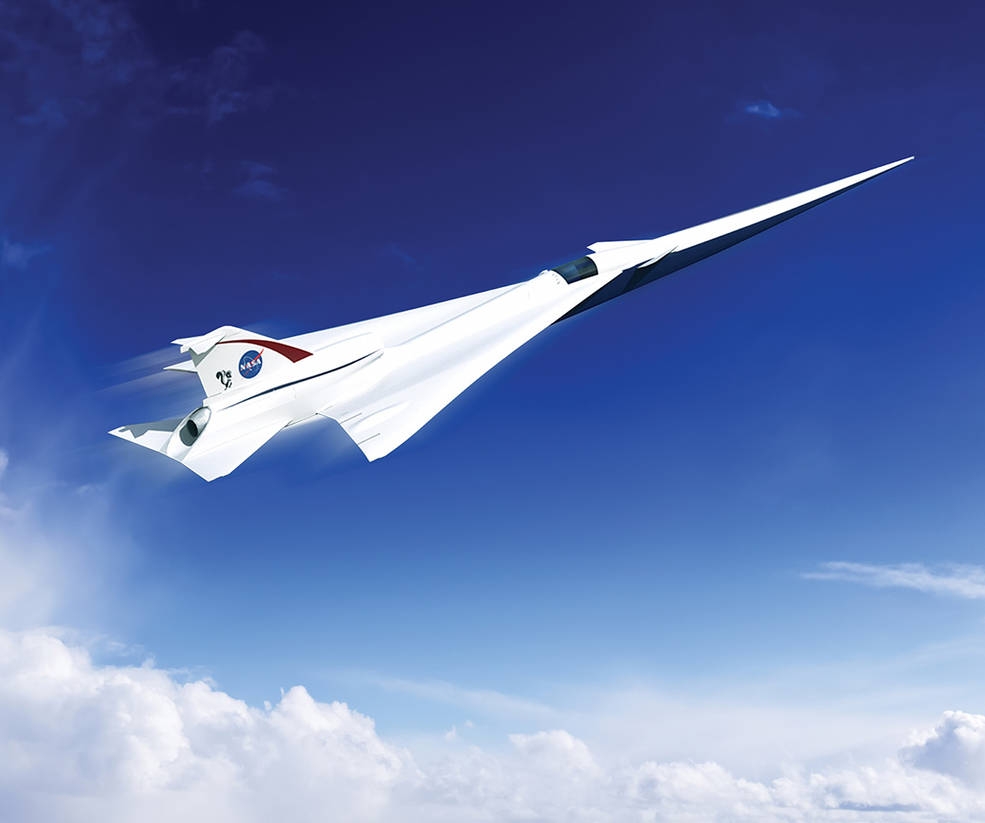
When the Concorde, a 1970s design, made its last flight in 2003, few may have guessed how hard it would be to achieve commercial supersonic flight once again. Aerospace companies have underestimated the challenges of developing a supersonic airliner ever since, though we might finally be getting close to overcoming the technological hurdles that have stymied supersonic air travel.
But there is still a major problem with breaking the sound barrier: You can't fly supersonic planes on standard over-land routes because nobody wants sonic booms shaking their neighborhood. For this reason, the Concorde had to fly out over the ocean before breaking the sound barrier.
It's a problem NASA hopes to solve with a Quiet Supersonic Technology (QueSST) demonstrator aircraft, a planned experimental X-plane that could hit Mach 1.42 while limiting the noise generated by a sonic boom. The agency is hoping the technology developed by Lockheed Martin's Skunk Works in the QueSST program can be implemented on business jets and eventually on 100- to 120-seat airliners.

"We believe the technology is ready," NASA's Commercial Supersonic Technologies (CST) project manager Dave Richwine told Aviation Week. "We feel we have got the sonic boom now to the stage where it is not going to be bothersome to the general public."
To reduce the sound of sonic booms, aerospace engineers need to find a way to prevent pressure waves from coalescing into a single shockwave. Just like waves in water created by a boat, air pressure waves build up on an aircraft. As the aircraft increases its speed, all the individual pressure waves are forced together into one shockwave traveling the speed of sound—about 768 mph depending on altitude. When the aircraft exceeds the speed of the shockwave, a sudden and dramatic change in pressure causes a sonic boom. It happens twice in rapid succession, actually, once when the pressure reaches its peak and once when it returns to normal. This is known as an N-wave for the way the pressure signature data looks when plotted.

To prevent N-waves, Lockheed Skunk Works is working on a single-engine aircraft design that would prevent pressure waves on different parts of the aircraft from coalescing into one large shockwave. A number of lifting surfaces will be used to keep shock waves separated, including a small T-tail on a vertical fin, canards ahead of the wings, and conventional horizontal tail wings. Those are all in addition to the main wings of the aircraft.
"They are designed to let us tailor the lift distribution and the strength of the shocks to keep them from coalescing before they impact the observer on the ground," Michael Buoanno, Lockheed Martin's chief engineer on the QueSST project, told Aviation Week.
The result should be an S-shaped wave signature—a series of small sonic booms that would sound more like a rumble than a dramatic thunderbolt clap. NASA hopes to ultimately develop a plane that makes less than 75 perceived noise level decibels (PNLdB), which is about 20 times quieter than the 105 PNLdB boom of the Concorde.
The nose of the QueSST is also extended to prevent shockwaves that form there from joining with pressure waves on other parts of the aircraft. However, the extended nose combined with the canard positions means that the pilot won't have enough natural visibility to operate the aircraft, so a video camera system and multifunctional display will be used—possibly the same one that is on the F-35 fighter jet.
A variant of the engine used on the F/A-18 Hornet, called the General Electric F404, is planned for the QueSST. Lockheed is currently looking for a contractor to build a wind-tunnel model of the aircraft that they could begin testing in the high-speed wind tunnel at NASA's Glenn Research Center by the end of the year. Low-speed tests will be conducted at Lockheed's own facilities, according to Richwine. If wind-tunnel tests go according to plan, we could see a QueSST X-plane fly as early as 2019.
Tecnam has announced a landmark strategic partnership aimed at accelerating the growth of its P2012 aircraft family across the United States. Under the agreement, Finnoff has been appointed the exclus...
TRU Simulation + Training Inc. will showcase its Veris Virtual Reality Flight Training Device (FTD) for the Cessna Skyhawk at NBAA-BACE 2026, marking the simulator's first appearance at the indust...
The International Aircraft Dealers Association (IADA) has released its 2026-2027 Current Market Portrait & Forecast, offering an in-depth analysis of the global preowned business av...
For the fourth consecutive year, Corsair is reaffirming its commitment to the fight against breast cancer by partnering with the association "Les Hôtesses de l’Air cont...

