

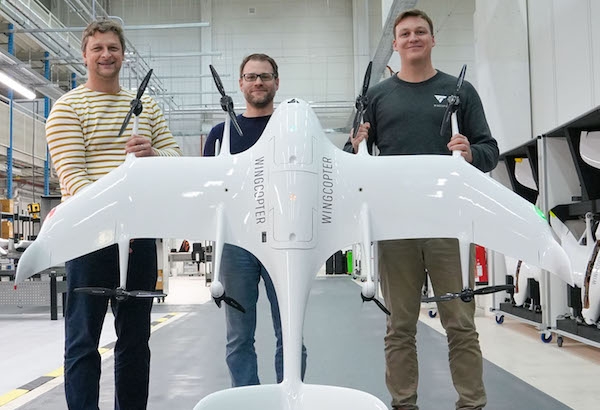
Wingcopter and Hamburg-based ZAL Center of Applied Aeronautical Research announced a development partnership. Together, they intend to explore the potential of green hydrogen to power Wingcopter's drones, which are already purely electric, and develop a sustainable, hydrogen-based propulsion system. The propulsion system will later be produced by Wingcopter itself and installed in its delivery drones. By refitting the battery-powered Wingcopter 198 to run on hydrogen, the plan is for the drone to not only continue to fly emission-free in the future, but to become even more powerful. The Wingcopter already achieves higher ranges and speeds than most competitors' models thanks to the added lift of its wings and its aerodynamic design. However, hydrogen propulsion could ensure even longer flight times and thus enable correspondingly greater distances for different delivery applications.
The project-related modification of the Wingcopter will take place at ZAL‘s Fuel Cell Lab in Hamburg. As part of the development partnership, a solution is being developed that will fit into the existing technical ecosystem of the Wingcopter delivery drone while preserving the characteristic flight capabilities of the Wingcopter. In the past, ZAL engineers have already been able to achieve a flight duration of over two hours with the company's own ZALbatros hydrogen drone. This was achieved using compressed gaseous hydrogen in combination with a fuel cell. A comparable technology will also be used in the Wingcopter.
Wingcopter co-founder and CEO Tom Plümmer, commented: "We are very excited about the collaboration and are confident that together we can develop an even more efficient propulsion solution that benefits nature at the same time. We have always wanted the Wingcopter to be able to fly even further. However, we categorically ruled out the installation of a conventional combustion engine right from the start with a view to the environment and climate change. We are happy to now explore technical possibilities in the field of hydrogen propulsion together with the ZAL experts and then put the best concept into practice."
Roland Gerhards, CEO of ZAL GmbH, said: “Our mission is to bring hydrogen into the air and create innovative solutions for sustainable aviation. With Wingcopter as our partner, we're not only impressed by their drones' flight performance, but also by their clear vision of how urban air mobility and especially drone delivery can help improve people's lives. This aligns perfectly with ZAL's values. With our expertise, we want to convert the Wingcopter to hydrogen and thus strengthen the Hamburg UAM network Windrove with another flagship project.”

Asco, a subsidiary of Montana Aerospace AG, achieves significant technological milestone in the development of a hybrid multi-material Rear Secondary Structure for Airbus. Montana Aerospace,...
The U.S. Federal Aviation Administration has certified the Boeing 737-10, the newest and largest member of the 737 MAX family, paving the way for Boeing [NYSE: BA] to begin customer deliveri...
MTU Maintenance and Garuda Indonesia have entered into a three-year agreement for the maintenance, repair and overhaul of the airline’s GE90-115B engines, which power its fleet of eight Boeing 7...
Affinity Aviation Group (AAG), a leading provider of business aircraft sales, acquisitions and charter solutions, has entered into a strategic collaboration with Austria’s AeronautX, reinforcing...