



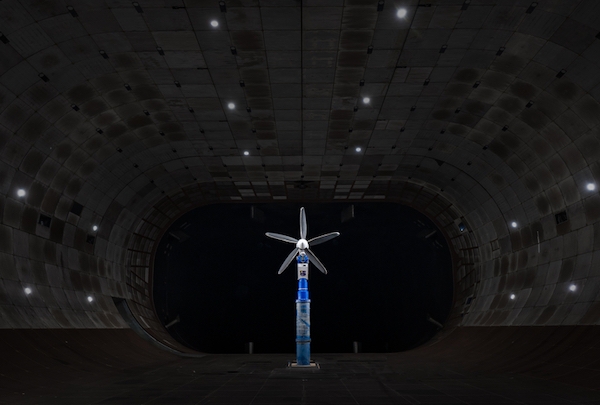
Joby Aviation is beginning testing at the National Full-Scale Aerodynamic Complex , world largest wind tunnel facility, at NASA’s Ames Research Center in California Silicon Valley. The NFAC, managed by the U.S. Air Force’s Arnold Engineering Development Complex, contains the two largest operational wind tunnels in the world. Data from propeller testing in the NFAC — widely considered to be the gold standard for aircraft aerodynamics and performance — was instrumental in the development of a range of iconic vehicles, including the space shuttle, the V-22 Osprey, the F-35 Joint Strike Fighter, and a number of next-generation helicopters. Joby is believed to be the first eVTOL company to test its propeller in the NFAC’s 40-by-80 foot wind tunnel.
JoeBen Bevirt, Founder and CEO of Joby, commented: “Testing is a critical part of our aircraft program and the opportunity to gather data on the performance of our propellers in one of the world’s largest wind tunnels is an exciting step toward commercialization. This facility helped introduce historic aircraft to the world, and now it’s doing the same for the next generation of sustainable aviation.”
Lt Col Tom Meagher, Lead for AFWERX Prime programs, said: “A cornerstone of the AFWERX Agility Prime program is fostering interagency partnerships and collaboration to progress the advanced air mobility segment. The NFAC testing is a perfect example of utilizing unique government test resources and infrastructure critical to enabling industry progression.”
The test campaign will cover all tilt angles and speeds through the expected flight envelope, providing Joby with consistent and high-fidelity data on the performance, loads, and acoustics of its propeller systems in support of its certification program with the Federal Aviation Administration (FAA).
Working in partnership with the U.S. Air Force and NASA, Joby is installing a production-intent electric propulsion unit and propeller assembly in the wind tunnel mounted to a six-degree-of-freedom force and moment balance to capture performance data. The blades are instrumented to measure the loads experienced while rotating, and a representative wing section of the Joby aircraft allows careful analysis of aerodynamic interference effects.
The NFAC propeller test campaign is expected to produce data of unparalleled quality – exceeding what is captured during normal flight testing – due to superior instrumentation and precise control of variables. The full test campaign is expected to take several months to complete.
With more than 1,000 test flights completed, Joby’s piloted, all-electric aircraft is designed to offer a faster and quieter method of aerial transportation across cities and communities with zero operating emissions. Joby expects to launch commercial aerial ridesharing service in the United States in 2025.
Emirates has officially inaugurated services to Helsinki, marking a significant milestone in connectivity between Finland and the United Arab Emirates. The new daily route is the only year-r...
Tecnam has announced a landmark strategic partnership aimed at accelerating the growth of its P2012 aircraft family across the United States. Under the agreement, Finnoff has been appointed the exclus...
Dutch flag carrier KLM, part of the Air France-KLM Group, has welcomed its first Airbus A350-900, marking a significant step in the airline’s long-haul fleet modernization strategy. The arrival...
Etihad Airways has signed an interline agreement with Nigerian airline Ibom Air, enabling travellers to connect seamlessly beyond Lagos and Accra to five destinations across Nigeria on a single t...

