

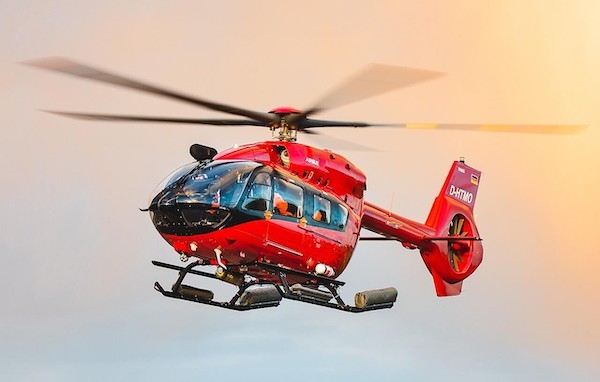
During European Rotors, Airbus announced the delivery of a five-bladed H145 to the German Operator HTM Helicopters – a year on, we sat down with the operator to check how the helicopter has proven itself in this industry. Helicopters are an important tool for the offshore wind industry – whenever maintenance of a wind park is necessary, whether it is planned or unplanned, helicopters are able to bring technicians and material in under one hour to wherever they are needed.
The deployment of offshore wind energy is at the core of delivering the European Green Deal. The installed offshore wind capacity in the EU was 14.6 GW in 2021 and the ambition of the European Union is to increase it by at least 25 times by 2030, using the vast potential of the five EU sea basins*. To keep the offshore wind parks running, helicopters are an important asset to transport technicians and material quickly to the place where they are needed – to keep Europe’s offshore wind parks running.

Sea State 6? No problem!
Remco Siemerink, Pilot and Manager Offshore at HTM Helicopters, said: “If maintenance is required, time is money – every hour a wind farm is not operational, the wind park operator loses money. We can bring and hoist the technicians and the material needed to maintain the wind farm in less than an hour. Even in conditions up to Sea State 6, which is considered a very rough sea with waves of up to six metres – a wave height at which the helicopter is the only available means of transportation that is still able to do the job.”
A typical crew for such a mission consists of two, one pilot and one technical crew member, who takes care of the technicians (of which there are usually up to three) and is also responsible for hoisting them to and from the wind turbine. “One mission usually takes around one hour – we fly 20 – 30 minutes to the wind turbine, hoist the three technicians and their equipment, which only takes us around one minute per hoist cycle, and fly back. The same the other way around in the afternoon.” To perform those missions safely, the helicopter is equipped with many features that support the pilot. “Helionix is great and intuitive – you always get the information you need and there are many options to customise the screens for the mission ahead. The 4-axis autopilot helps us to stabilise the helicopter, which is especially important when we are hoisting our passengers.”

2000 missions and counting
HTM Helicopters, that has been flying a four-bladed H145 since 2014, took delivery of the latest version of the helicopter family with its innovative bearingless main rotor system a year ago: “The five-bladed H145, which we operate from our base in Norddeich to fly to Borkum Riffgrund 1+ 2 and GodeWind 1+2 has proven to be the ideal helicopter for our missions. The increased useful load compared to the previous version gives us an additional margin, while the smoother ride is great for both crew and our technicians on board”, adds Siemerink. In the last year, the five-bladed H145 has successfully completed more than 2000 missions, clocking more than 400 flight hours. “The performance of the H145 is great. In both summer and winter, the H145 is very powerful - we have no problems at all.” The unobstructed cabin is also a plus for the H145, which allows the crew to hoist both technicians and equipment one after another towards the windfarm. “With other helicopters you often cannot do that, as you have a separated passenger and cargo compartment.”
In the offshore wind business since 2008
“We operate a fleet of three H135s and two H145s for the offshore wind part of our business in Germany and France. Our main bases are Helgoland, Emden and Norddeich in the north of Germany and we recently added a new one in France at La Baule airport, which is close to Nantes”, says Siemerink. Last year alone, the H135 and H145 fleet clocked more than 1300 flight hours. “The current energy crisis has shown that renewable energies are the future and with wind parks becoming bigger and being located farther away from the coast, we expect the helicopter to play a vital role in supporting and maintaining them.”
*(Source: https://energy.ec.europa.eu/topics/renewable-energy/offshore-renewable-…)
Archived
3 years ago
Airbus 2026 Cargo Global Market Forecast, unveiled at the Cargo Facts Symposium, predicts that the global fleet of dedicated freighter aircraft will expand by 46%, rising from 2,360 aircraft in 2026 t...
Bombardier announced plans to further expand its presence across the United States, with the creation of 800 jobs supported by ongoing growth initiatives and strategic infrastructure investments. ...
Air Baltic Corporation AS , Latvia’s national airline and the leading carrier in the Baltic States, announced that airBaltic and its subsidiaries participating in the voluntary Ch...
Private jet catering requires an understanding of the journey as much as the passengers' preferences. SkyDine Jet Catering explores how flight duration, departure schedules, airport location, and...