



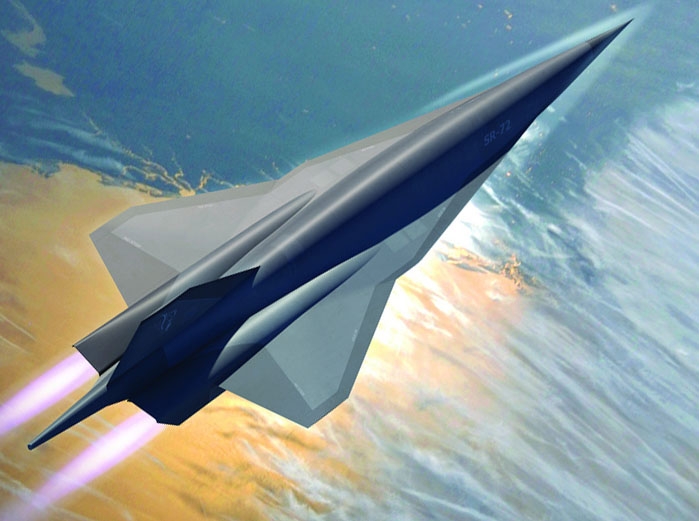
Lockheed Martin’s unmanned SR-72 aircraft concept has surfaced again with renewed vigour, with company leadership now pushing a reusable, air-breathing hypersonic vehicle as an “affordable” way to validate a new propulsion concept for achieving speeds within the atmosphere between Mach 6.0 to Mach 20.
Speaking at a Lockheed media event in Washington DC on 15 March, company chief executive Marillyn Hewson confirmed that the company is building on “several breakthroughs” made during the short-lived HTV-3X Blackswift hypersonic testbed, which was de-funded by Congress in fiscal year 2009, to develop “a controllable, low-drag aerodynamic configuration capable of stable operation from takeoff to subsonic, transonic, supersonic and hypersonic to Mach 6”.
Lockheed SR-72
Lockheed Martin
Hewson, while displaying an artist’s rendering of the SR-72, said it would cost “less than $1 billion” to develop and fly a demonstrator aircraft the size of an F-22 Raptor.
Devised by Lockheed’s Skunk Works division, SR-72 employs a turbine-based combined cycle propulsion system to get above "Mach 1.5 to 2.0," at which point it would begin converting to a supersonic combustion ramjet for speeds beyond Mach 6.
That’s according to Skunk Works head Rob Weiss, who confirmed that it would be an unmanned vehicle, at least at first. Hewson says the company’s long-term ambition is to “enable hypersonic passenger flights and easier access to space”.
The company’s militarised spinoffs could be an air-breathing, hypersonic reconnaissance aircraft, or perhaps even new fighters and bombers further along.
Weiss says there is government interest but no programme of record currently, although DARPA might want to pick up where Blackswift ended and launch a proof-of-concept demonstration.
Lockheed revealed its next-generation version of the famed SR-71Blackbird, the SR-72, in 2013 and has said it would hope to introduce a reusable hypersonic aircraft in the mid-2020s or so. The challenge is transitioning through Mach 3.0 – since modern turbojet engines are only capable of powering an aircraft to Mach 2.2, whereas typical ramjets don’t work below Mach 4.0.
Hewson and Weiss pointed to Lockheed's investments in hypersonic propulsion technology and high-temperature materials but didn’t say exactly how their concept will transition to from zero all the way up to hypersonic speeds except through combined propulsion technologies.
In addition, the company is pushing super-fast, rocket-boosted weapons. Weiss says Lockheed will submit proposals for DARPA’s Tactical Boost Glide (TBC) and Hypersonic Air-breathing Weapon Concept (HAWC) demonstration programmes “later this month or in early April”.
DARPA
TBG, a high-speed glide weapon launched from a common vertical launch silo, follows in the Mach 20 contrails of the Falcon HTV-2 experiments that failed in 2010 and 2011.
HAWC, meanwhile, builds on HyFly and the Boeing X-51A scramjet demonstration that ended successfully in 2013 after four flights.
Funding for TBG jumps from $11.2 million to $22.8 million in DARPA’s spending blueprint for fiscal year 2017, and HAWC funding rises from $13.5 million to $49.5 million over the same period.
“Twenty-sixteen will be a decision on winners; more than one, likely, on one or both programmes,” says Weiss, adding that flight tests are planned for 2018.
Etihad Airways has signed an interline agreement with Nigerian airline Ibom Air, enabling travellers to connect seamlessly beyond Lagos and Accra to five destinations across Nigeria on a single t...
Boeing and Ethiopian Airlines have announced a new cargo fleet expansion agreement, with the African carrier ordering eight 777-8 Freighters and two additional 777 Freighters. The investment will enab...
The International Aircraft Dealers Association (IADA) has released its 2026-2027 Current Market Portrait & Forecast, offering an in-depth analysis of the global preowned business av...
FL Technics Indonesia, the first MRO in Indonesia to be appointed as a GE Aerospace avionics support partner, has signed a service support agreement with GE Aerospace covering Boeing 737 and Airbus A3...

