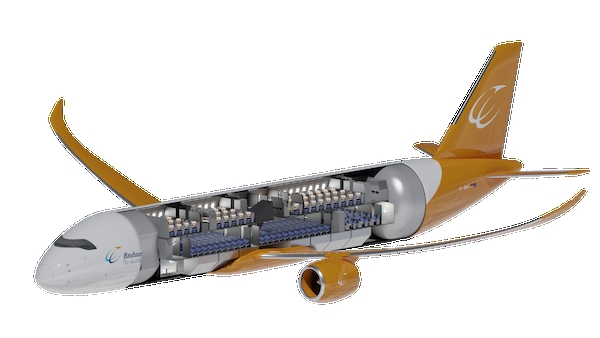
Radical technical and operational efficiency, 100 per cent renewable energy sources (such as SAF and hydrogen) and climate-impacting measures on operational level — these are the three main approaches being considered for climate-friendly aviation. However, only concerted action by all stakeholders in global aviation and beyond can achieve this goal.
Prof. Dr. Mirko Hornung, Executive Director Research and Technology at Bauhaus Luftfahrt commented: “A transition to climate-friendly aviation will require a major push at all levels: radical aircraft architecture changes, a rapid ramp-up of sustainable aviation fuels and hydrogen as an energy source, and flight operations optimised for climate protection from start to finish." For two decades, the Munich-based think tank has been researching the air transport of the future and is now defining central milestones on the road to climate-friendly aviation.
- Production of Sustainable Aviation Fuels (SAFs) must be ramped up rapidly. Over the long term, power-to-liquid (PtL) has the greatest potential, using sustainable electricity and carbon captured from the air. Sustainable biofuel pathways can help provide the necessary quantities of fuel as a bridging technology.
- In every future scenario, green hydrogen is an essential building block. PtL fuel production requires the availability of large quantities of ‘green’ hydrogen. Using hydrogen as a fuel itself could radically revolutionise the entire aviation industry and eliminate CO2 emissions in the long term.
- However, SAFs and hydrogen will always be more expensive to produce than fossil-based kerosene. To limit the increase in operating costs, and the necessary quantities of SAFs, aircraft efficiency will have to increase by about 50 per cent. At the same time, policy frameworks, financial measures and market mechanisms must make sustainable fuel sufficiently attractive to airlines, encouraging them to purchase it even without quotas.
- We need to use all the technology options available to achieve the necessary efficiency increases, including many well-known technologies that reduce weight and improve aircraft aerodynamics — both of which help to reduce the thrust required. Innovative engine technologies use less fuel and reduce emissions. Artificial intelligence calculates the best flight routes in real time to prevent condensation trails (without increasing fuel consumption due to detours).
- The use of more streamlined wings with a greater span is a very effective way of increasing efficiency. Yet this is often limited by the dimensions at airports today — based on standards set about eight decades ago. This is where adjustments are needed to exploit the technical potential.
- At the operational level, there are also many climate-impacting measures. Examples of effective measures would be to switch from connecting flights to direct flights for long-haul travel, to implement cross-airline capacity management (aircraft sharing) and to strengthen multimodal networking for short-haul travel.
- Massive investments are needed to produce sustainable fuels, develop new, significantly more efficient aircraft, and establish appropriate infrastructure. Making this a reality and rolling it out across the market on a large scale requires massive investment within and outside the aviation sector. The success of climate-friendly aviation will also depend on making these investments as soon as possible and ensuring that the transition quickly penetrates the global fleet.
- None of the scenarios results in completely carbon neutral aviation by 2050. This is partly due to emissions, especially from the production and provision of energy sources. Offsetting these scope 3 emissions will always be necessary.
- None of the stakeholders — politicians, manufacturers, airlines or airports — can initiate and drive these developments alone. New fuels, aircraft types and infrastructures require concerted action by all stakeholders in global aviation and beyond.