



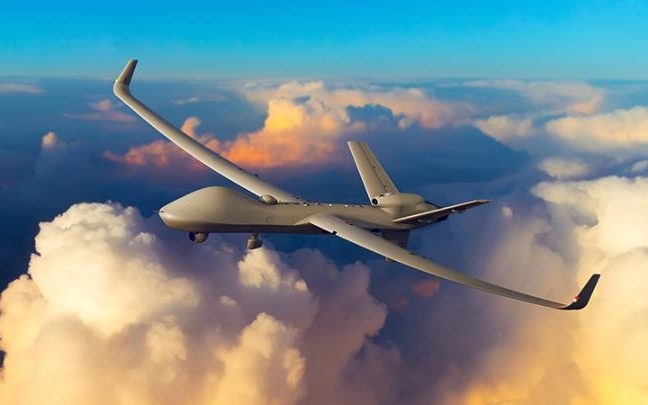
Britain will double its fleet of armed surveillance drones with a new upgraded generation of unmanned aircraft able to fly for nearly twice as long, laden with more bombs, missiles and sensors, the MoD has disclosed.
The 79ft wingspan, remotely piloted planes will be able to circle over and spy on targets for nearly two days, while sophisticated new flight computers mean they will be able to fly in bad weather and survive ice, lightning and bird strikes.
The new General Atomics Certifiable Predator B, which is expected to be named Protector when used by the RAF from the end of this decade, is likely to be at the forefront of spying and air strike campaigns against militant and terror groups such as Islamic State.
First details of the new aircraft have been disclosed as defence officials signed a £415m contract with the Pentagon to buy 20 of the new drones to replace the RAF’s 10 existing MQ-9 Reapers.

The 38ft long aircraft will also be certified to fly in European airspace, allowing them to be potentially used in Nato intelligence-gathering missions in eastern Europe, or even over the UK and its waters.
Liz Quintana, director of military sciences at the Royal United Services Institute, said: “The aircraft is much more capable than its predecessor. It has almost double the endurance of the Reaper so with a fleet of 20 aircraft, this represents an almost quadrupling of the capability, vital given the MoD's range of commitments and its requirement to respond to emerging crises."
Defence experts said the drone, which is still being developed, was likely to at first carry the same Hellfire missiles and laser-guided bombs as the Reaper, but other weapons could eventually be added.

Protector will be able to stay airborne for more than 40 hours, controlled by satellite link by pilots at RAF Waddington in Lincolnshire. The Reaper can currently stay aloft for around 25 hours.
Huw Williams, unmanned systems editor at IHS Jane's, said: “We are looking at increasing endurance. The longer you can stay on station, the better. It will also have more hard points to attach sensors and weapons."
The RAF’s Reaper drones are believed to be all currently deployed in the Middle East, where they have flown hundreds of missions over Islamic State territory in Iraq and Syria.
Sources said defence chiefs had suggested the name Protector, rather than its original name of Predator, in an attempt to change public perceptions that drones are unaccountable killing machines.
FL Technics Indonesia, the first MRO in Indonesia to be appointed as a GE Aerospace avionics support partner, has signed a service support agreement with GE Aerospace covering Boeing 737 and Airbus A3...
Tecnam introduces the P2008JC NG to the United States market, bringing flight schools a certified, next-generation training aircraft designed to dramatically reduce operating costs while maximizing fl...
Emirates has officially inaugurated services to Helsinki, marking a significant milestone in connectivity between Finland and the United Arab Emirates. The new daily route is the only year-r...
A new travel industry coalition is urging EU policymakers to adopt a balanced and proportionate approach to biometric travel, ensuring passengers can benefit from secure and seamless journeys while ma...

