



As the industry moves toward emission-free aviation, MTU Aero Engines welcomes the ZEROe concepts from European aircraft manufacturer Airbus. “Hydrogen is a highly attractive future option for us as an engine producer as well,” says MTU Chief Operating Officer Lars Wagner. “It should be used as a fuel right away,” he adds.
Germany’s leading engine manufacturer sees three possible uses for hydrogen: Converted to sustainable aviation fuels (SAFs), hydrogen could be dropped into existing aircraft and engines right away. “Direct combustion of liquid hydrogen in gas turbines is possible in technical terms, too,” says Dr Stefan Weber, Senior Vice President Technology & Engineering Advanced Programs at MTU in Munich, highlighting the second possible use. That would require some adjustments in the engine, especially the combustion chamber, which Weber thinks could be done in just a few years. By contrast, much larger challenges await for infrastructure and aircraft manufacturers, since they will have to find ways to provide and transport the liquid hydrogen and then carry it along inside appropriate tanks inside the aircraft.
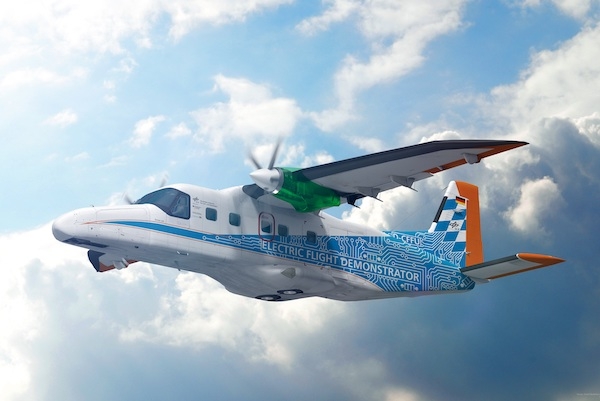
In the long term, MTU is relying on a third option for using hydrogen: converting it into electricity by means of a fuel cell. This application is also described by the MTU experts in their Technology Roadmap for achieving emissions-free flight. This technology promises almost zero emissions, but it is still in the early stages of development in aircraft propulsion applications. “We call our fuel cell concept the flying fuel cell. We have an established team of experts working on it in Munich,” Weber explains. In August, MTU teamed up with the German Aerospace Center (DLR) to launch a cooperative project with the aim of demonstrating the new technology in a Do228.
MTU’s development work is also focusing on the further development of the gas turbine to leverage the full amount of potential available. Further optimized and combined with revolutionary drive concepts that significantly improve the cycle, considerable reductions in all emissions can be achieved. MTU is currently focusing on what is known as a WET engine (Water-Enhanced Turbofan). This concept reduces fuel consumption by more than 15 percent regardless of fuel type, considerably lowers all emissions – especially NOx levels – and, according to initial estimates, also reduces formation of contrails.
Lars Wagner explains: “We need both propulsion concepts – an optimized gas turbine combined with WET technology and fuel cells – because they have different areas of application.” The hydrogen-powered fuel cell is especially suitable for short- to medium-haul aircraft, as it requires less tank volume than in the case of long-haul aircraft. For these types of planes, gas turbines will continue to make sense for the foreseeable future. “But in that case, using SAFs,” Dr Stefan Weber sums up, adding, “Realizing the new technologies, and reaching our climate targets, will depend to a crucial degree on receiving appropriate funding, both nationally and at the European level.”
Emirates has officially inaugurated services to Helsinki, marking a significant milestone in connectivity between Finland and the United Arab Emirates. The new daily route is the only year-r...
Dutch flag carrier KLM, part of the Air France-KLM Group, has welcomed its first Airbus A350-900, marking a significant step in the airline’s long-haul fleet modernization strategy. The arrival...
Boeing and Ethiopian Airlines have announced a new cargo fleet expansion agreement, with the African carrier ordering eight 777-8 Freighters and two additional 777 Freighters. The investment will enab...
TRU Simulation + Training Inc. will showcase its Veris Virtual Reality Flight Training Device (FTD) for the Cessna Skyhawk at NBAA-BACE 2026, marking the simulator's first appearance at the indust...

