



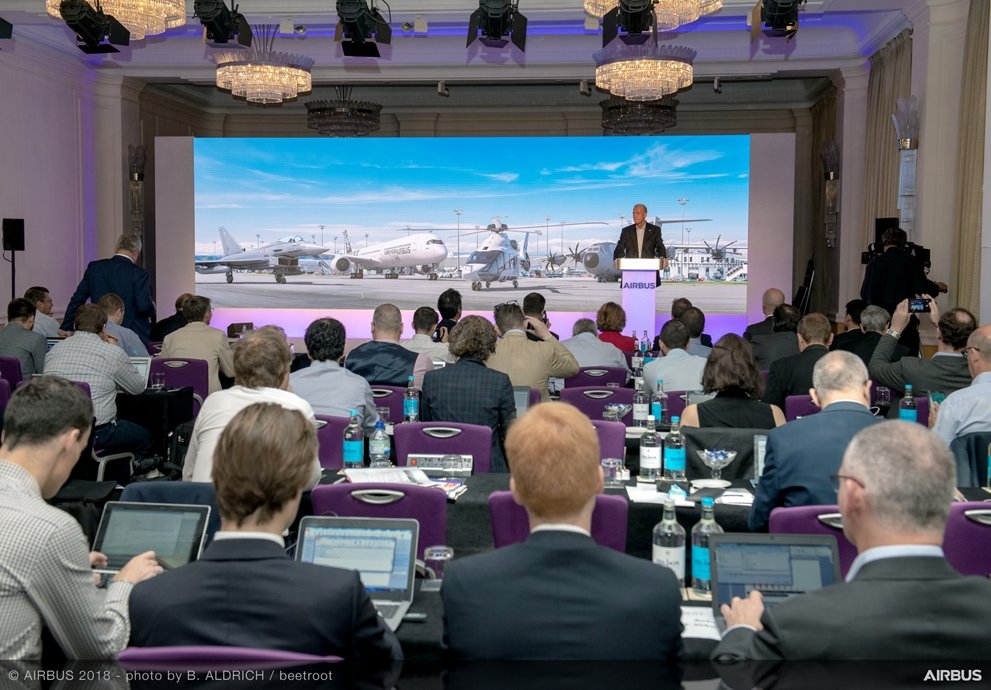
#AirbusGMF Global networks and citizens drive growth of 4.4% a year
The world’s passenger fleet will more than double to 48,000 aircraft in 20 years with traffic growing at a resilient 4.4% per year, driving a need for 37,390 new passenger and freighter aircraft according to Airbus’ new Global Market Forecast 2018-2037.
Growth drivers include private consumption increasing 2.4 times in emerging economies, higher disposable incomes and a near doubling of the middle classes globally. Emerging countries will account for over 60% of economic growth, with trips per capita to multiply 2.5 times for these nations. Combined with evolving airline business models and continuing liberalisation, the growing scale of air transportation will lead to an increasing resilience to regional slowdowns.
Greater aircraft range and capacity through technological developments allow airlines the flexibility to explore new business opportunities whilst maintaining focus on cost reduction.
“There is a growing trend to use aircraft across a broader range of operations, with today’s more capable aircraft blurring the boundaries between market segments. These realities made us develop a new segmentation with Small, Medium, Large and Extra-Large categories, reflecting more closely the way airlines operate aircraft,” said Eric Schulz, Airbus Chief Commercial Officer.” “Thanks to the versatility of our leading, most comprehensive Family of aircraft, the top end of our single aisles, the A321neo, fly efficiently on long haul routes and our wide bodies like the A330neo equally serve regional operations. We’re extremely strong in this Medium market segment.”
Airbus already leads in the Small (S) segment with the A320neo and in the Large (L) segment with the A350-900. In the Extra-Large (XL) segment, the market for replacement aircraft is just starting and provides opportunities for the very efficient A350-1000 combined with the A380.
Looking at the four segmentations more closely, in the Small segment typically covering the space where most of today’s single-aisle aircraft compete, there is a forecast future requirement for 28,550 new aircraft, representing more than three-quarters of total expected demand. In the Medium segment, for missions requiring additional capacity and range flexibility, represented by smaller widebodies and longer-range single-aisle aircraft, Airbus forecasts demand for 5,480 passenger and freight aircraft. For additional capacity and range flexibility, in the Large segment where most A350s are present today, there is a need for 1,760 aircraft. In the Extra-Large segment, typically reflecting high capacity and long range missions by the largest aircraft types including the A350-1000 and the A380, Airbus forecasts demand for 1,590 aircraft over the next 20 years.
Of the 37,390 new aircraft required, 26,540 are for growth and 10,850 will replace older generation less fuel efficient aircraft. The more than doubling in the world fleet to 48,000 aircraft results in a need for 540,000 new pilots. Airbus continues to evolve its service business to meet the needs of its growing customer base.
For the GMF related material, go to: https://www.airbus.com/aircraft/market/global-market-forecast.html
The International Aircraft Dealers Association (IADA) has released its 2026-2027 Current Market Portrait & Forecast, offering an in-depth analysis of the global preowned business av...
Azerbaijan Airlines (AZAL), part of AZCON Holding, has taken delivery of another Airbus A321neo, increasing its fleet to 31 aircraft as the carrier continues its long-term modernisation strategy. The...
flyadeal, the fast-growing low-cost carrier of Saudia Group and one of the GCC's largest budget airlines, has expanded its presence in India with the launch of non-stop flights between Riyadh and...
A new travel industry coalition is urging EU policymakers to adopt a balanced and proportionate approach to biometric travel, ensuring passengers can benefit from secure and seamless journeys while ma...

