



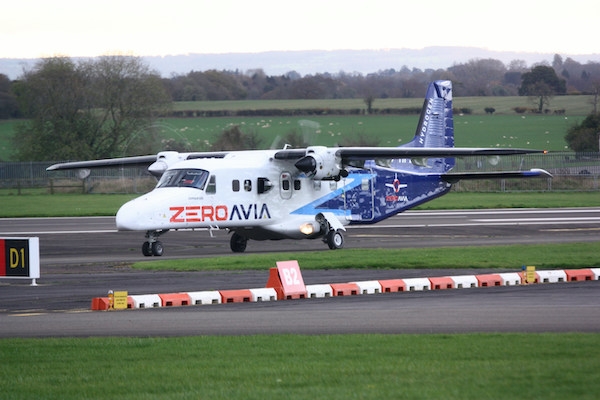
UK's Civil Aviation Authority has granted a permit to fly for ZeroAvia Dornier 228 aircraft, which has been retrofitted with its prototype hydrogen-electric powertrain. ZeroAvia secured the permit to fly following an extensive ground testing campaign and a rigorous review of the full development program. It means that ZeroAvia can now begin the first test flights of its 600kW hydrogen-electric powertrain. The 19-seat twin-engine aircraft has been retrofitted in an engineering testbed configuration to incorporate ZeroAvia's hydrogen-electric engine powering the propellor on its left wing, operating alongside a single Honeywell TPE-331 stock engine on the right for appropriate redundancy to allow the safe testing of the novel propulsion technology.
The test flights are set to be a landmark achievement for ZeroAvia and the HyFlyer II project, a major R&D program backed by the UK Government's ATI Programme, which targets the development of a 600kW hydrogen-electric powertrain for 9-19 seat aircraft.
Val Miftakhov, Founder & CEO of ZeroAvia commented: "Earning our full Part 21 permit to fly with the CAA is a critical milestone as we develop a zero-emission aviation propulsion system that will be the most environmental and economical solution to the industry's climate impact. We're going to be starting 2023 in the best way possible, by demonstrating through flight that true zero-emission commercial flight is much closer than many think."
For this testing program, ZeroAvia has worked with the CAA in meeting a far more stringent set of requirements when compared to the E-Conditions framework ZeroAvia had used for its 6-seat prototype in 2020. Part 21 is an industry-standard term used to describe the regulatory approval of aircraft design and production organizations, and the certification of products, parts, and appliances for aircraft. Securing this permit to fly is a significant milestone in ZeroAvia's path towards commercialization.
It will pave the way for a commercially certifiable configuration for ZA600 to be submitted by the end of 2023, ahead of delivering powertrains for the first commercial routes for 9-19 seat aircraft to commence by 2025. With 1,500 engines under pre-order, partnerships with seven aircraft manufacturers and multiple fuel and airport partnerships, ZeroAvia is well positioned to lead the industry's transformation to a clean future. When test flights begin in January, ZeroAvia's Dornier 228 testbed is expected to become the largest aircraft to ever fly using a hydrogen-electric powertrain.
The International Aircraft Dealers Association (IADA) has released its 2026-2027 Current Market Portrait & Forecast, offering an in-depth analysis of the global preowned business av...
Dutch flag carrier KLM, part of the Air France-KLM Group, has welcomed its first Airbus A350-900, marking a significant step in the airline’s long-haul fleet modernization strategy. The arrival...
Emirates has officially inaugurated services to Helsinki, marking a significant milestone in connectivity between Finland and the United Arab Emirates. The new daily route is the only year-r...
PAL-V has signed a Memorandum of Understanding with AVION, a specialist in advanced flight training devices, and FLYVE, a developer of FlyDrive ecosystems for professional and government operator...

