



BY DAVID PARKER BROWN
Honeywell recently reached out and let me know that their Boeing 757 would be parked at Paine Field (north of Seattle) overnight. They asked if I’d like to take a tour before it departed back to Phoenix. Um… yes please!

The third engine on the side of the 757, with a B-52 in the background
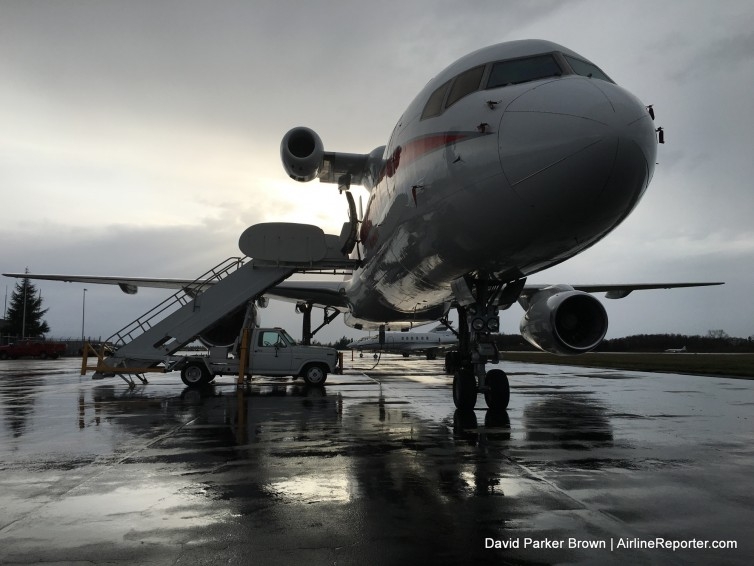
The rain partly cleared as I arrived and the first obvious difference between Honeywell’s 757 and the run-of-the-mill 757 is the third engine on the side of the fuselage. The engine mount is used to test different Honeywell engines in the “real world.” During my tour, the Honeywell TFE731 engine was hooked up and it was being tested for vibration issues.

Looking towards the rear of the plane
The Boeing 757-200 was “born” in 1983 and delivered to Eastern Air Lines as N504EA. In 1995, the plane was sold to Airtours and re-registered as G-JALC. Then in 2002, it went to My Travel Airways before being stored for a few months. In 2005, Honeywell purchased the aircraft and then registered it as N757HW (cool reg, right?).
Although some of the original passenger interior can be seen (the side walls in the back), most of it was stripped and the plane was configured to be a test bed.

New Boeing aircraft are in the distance at Paine Field
The pylon for the third engine was designed in a way that does not affect much of the overall handling characteristics of the 757. According to the pilots, the only time where there is a noticeable difference is during faster-than-normal flight during testing. Even then, it can be easily offset.

Some of the Honeywell work stations

Full-on oxygen mask and helmet in care of an emergency

Looking towards the back of the plane
Walking inside the 757, we first headed toward the back of the plane, which had a number of different computer stations. The stations use different software to test not only aspects of the engine attached to the side, but also other possible equipment being tested on board. In this case, they were testing things other than the third engine, including the Inmarsat Global Xpress broadband internet.

The inside of the Honeywell 757
Before each flight, the aircrew creates a flight profile to figure out the altitudes, type of weather, and length that will be needed for each test flight.
The equipment allows them to get results in real-time. Instead of just collecting data to be analyzed on the ground later, they are able to come to conclusions in the air, before landing. What the program is really doing is producing accurate data.

Seats with headsets

Overhead bins

The “first class” cabin
For the most part, the aircraft is self-sustaining. They even carry spare parts in the cargo haul and have two mechanics on board during operations. And for guests on the flight, there are two rows of old-school first class seats up front. When are first class seats the worst seats in a plane? When they are on this Honeywell 757 with so many better seats — including those in the very front.

The 757 controls

The 757 flight deck

Close-up of some of the gauges
Sitting down in the cockpit, I was able to speak to Chief Test Pilot Joe Duvall. He has flown a number of different aircraft types during his career and still actively flies both Honeywell’s Boeing 757 and classic Convair. When I asked which was his favorite to fly, he explained that he loved them both for different reasons. A mostly empty Boeing 757 is like a sports car, but the Convair is like how flying used to be — much more hands-on and attached to the experience. I would say he has a pretty cool job!

Honeywell’s Sabreliner pulls in at Paine Field
Almost like it was perfect timing, as I departed the 757, another Honeywell jet landed – their Sabreliner. Captain Duvall explained this was a special experience. Due to the testing locations and schedules it is rare for the two birds to be together. Only if the Convair was there too, but not on this day.


Riyadh Air celebrated the launch of its inaugural service between Riyadh and Kuala Lumpur, establishing its first gateway into Southeast Asia. The inaugural event was celebrated in both cities, kickin...
Atoms and Joby Aviation announced a strategic partnership to acquire and develop vertiport sites in the United States. The companies will initially focus on Florida, New York, and Texas, the markets w...
Capital Jets, an aircraft management company and 14 CFR Part 135 aircraft operator, has expanded its operations with the addition of a Learjet 60XR. Based at Fort Lauderdale-Hollywood Internation...
U.S. Federal Aviation Administration has granted Boeing an amended type certificate for the new 737-7 airplane, clearing it for commercial service. The smallest...

