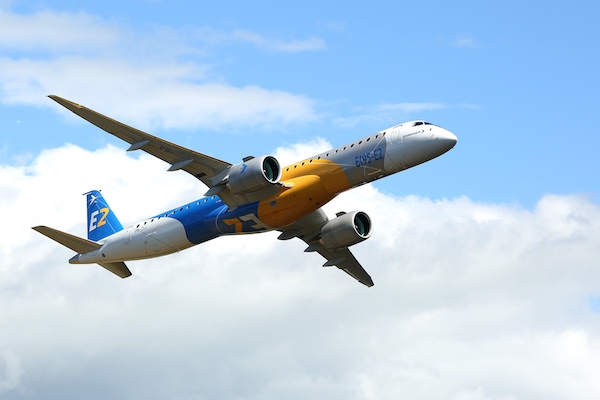
Pratt & Whitney has signed a memorandum of understanding with Embraer to collaborate on studies of 100% sustainable aviation fuel (SAF). Technical teams from the two companies will engage to define an integrated ground and flight test plan for 100% SAF in a GTF-powered Embraer E195-E2 aircraft.
The initiative reflects Pratt & Whitney’s and Embraer’s shared commitment to supporting the aviation industry’s ambitious environmental goals, including the goal of reaching net zero CO2 emissions for air travel by 2050. Alongside efforts to continually improve aircraft and engine efficiency, SAFs have a critical role to play towards decarbonizing air travel by reducing dependence on fossil-based fuels.
SAFs are manufactured from renewable feedstocks, such as used cooking oil or municipal solid waste, and may reduce lifecyle CO2 emissions by up to 80% relative to fossil-based jet fuel. Today, technical standards devised by ASTM International allow aircraft to operate with SAF at blends of up to 50% with kerosene. Collaboration among OEMs, fuel providers, and regulators, will enable new standards to certify operation with 100% SAF.
“Pratt & Whitney has been active in SAF testing and certification for almost two decades. We will strategically continue to support 100% SAF flight tests for key customers that expand SAF uptake, including partnering with Embraer to test the E-Jets E2 aircraft on 100% SAF as part of their 2050 net zero emissions target,” said Graham Webb, Chief Sustainability Officer at Pratt & Whitney. “Through our constant pursuit of more efficient aircraft propulsion technologies, we are determined to support our customers in achieving their goal of net zero CO2 emissions by 2050, and will ensure that our engines will be ready for operation with 100% SAF.”
“We are committed to continually enhancing the efficiency and performance of our products, and by further extending their compatibility with SAF, we will enable our customers to operate as sustainably as possible,” said Arjan Meijer, President and CEO, Embraer Commercial Aviation. “Embraer has a recognized track record of innovation in sustainable fuels, which includes the industry's first certified ethanol-powered aircraft in 2004, and collaboration is an essential pre-requisite for our industry to achieve our environmental goals. We are delighted to partner with Pratt & Whitney towards this critical task of enabling aircraft operation with 100% SAF.”
Powered by Pratt & Whitney GTF™ engines, the Embraer E195-E2 offers more than 24% better fuel efficiency and lower CO2 emissions per seat than the previous generation E195. Pratt & Whitney powers a range of other Embraer aircraft, including the Phenom 300 and 100 series executive jets, and the C-390 Millennium military transport aircraft, which uses IAE V2500 engines.
Oriens Aviation has appointed Narine Melkumjan as Sales Manager for the Netherlands, strengthening its presence in the Dutch market following its designation as Tecnam’s exclusive dealer in the...
Airbus 2026 Cargo Global Market Forecast, unveiled at the Cargo Facts Symposium, predicts that the global fleet of dedicated freighter aircraft will expand by 46%, rising from 2,360 aircraft in 2026 t...
Electra has successfully completed the takeoff and landing of its hybrid-electric Ultra Short aircraft at Downtown Skyport in Lower Manhattan, in what is believed to be the first time a fixed-wing air...
Cirrus Aircraft has broken ground on a new 15,000-square-foot Engine Run-Up Center that will centralize engine testing, fuel calibration and certification activities for the SR Series, Vision Jet and...