



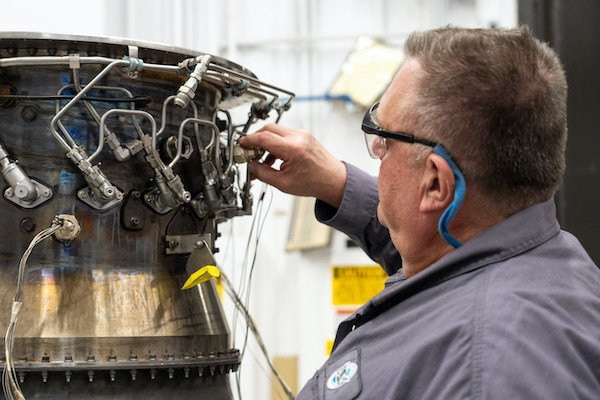
Pratt & Whitney and the Federal Aviation Administration will work together with Missouri University of Science and Technology, Aerodyne Research and the Environmental Protection Agency to study non- CO2 aviation emissions, to help understand and reduce the environmental impact of those emissions. As part of the FAA ASCENT program, the project will measure emissions from a Pratt & Whitney GTF engine combustor rig test stand using conventional Jet A and 100% sustainable aviation fuel.
Sean Bradshaw, senior technical fellow of sustainable propulsion at Pratt & Whitney commented: "As the aviation industry targets a goal of net-zero CO2 emissions by 2050, we continue to pay close attention to addressing the environmental impact of other emissions, including cruise non-volatile particulate matter and NOx. Combustor rig tests with 100% SAF provide a controlled environment for generating valuable baseline data, which will support future studies using full scale engines on-wing at ground and flight test conditions."
Dr. Philip Whitefield of Missouri University of Science and Technology said: "By bringing together expertise from industry, government, and academia, this project represents an important step towards understanding and reducing the environmental impacts of aviation, including those arising from non-CO2 emissions. SAF containing low sulfur and aromatic hydrocarbon concentrations could contribute to reduced sulfur dioxide and non-volatile particulate emissions, which are associated with contrail formation and the impact to global warming."
The project will compare emissions from Jet A kerosene and SAF comprised of 100% Hydroprocessed Esters and Fatty Acids Synthetic Paraffinic Kerosene (HEFA-SPK), a biofuel derived from vegetable oils and animal fats; the fuel is supplied by World Energy. The rig tests will take place at Pratt & Whitney's facility in Middletown, Conn., using an advanced Rich-Quench-Lean combustor. The rig allows testing of the full range of combustor operating conditions, including at take-off, ground, and cruise altitudes, to help understand the environmental and emissions benefits of using SAF. Pratt & Whitney, the FAA, Missouri S&T, Aerodyne Research, and the EPA will collaborate on test design, execution, and emissions data analysis.
Joby Aviation signed a lease for 45,000 square feet at Alliance Air Trade Center in Haslet, part of Perot Field Fort Worth Alliance Airport. Located within Hillwood’s 27,000-acre AllianceTexas d...
Volatus Aerospace announced the next phase of its national wildfire response initiative through a strategic partnership with Singular Aircraft, developer of the FlyOx 1 multi-mission heavy-lift autono...
Avelo Airlines reached a major milestone, flying its 10 millionth Customer just five years after redefining affordable air travel in as America's most convenient airline. Since launching on April...
Summer high season in Spain is always a defining period for general aviation sector, and this year is no exception. With the first two months already behind us, preliminary results are offering a clea...

