



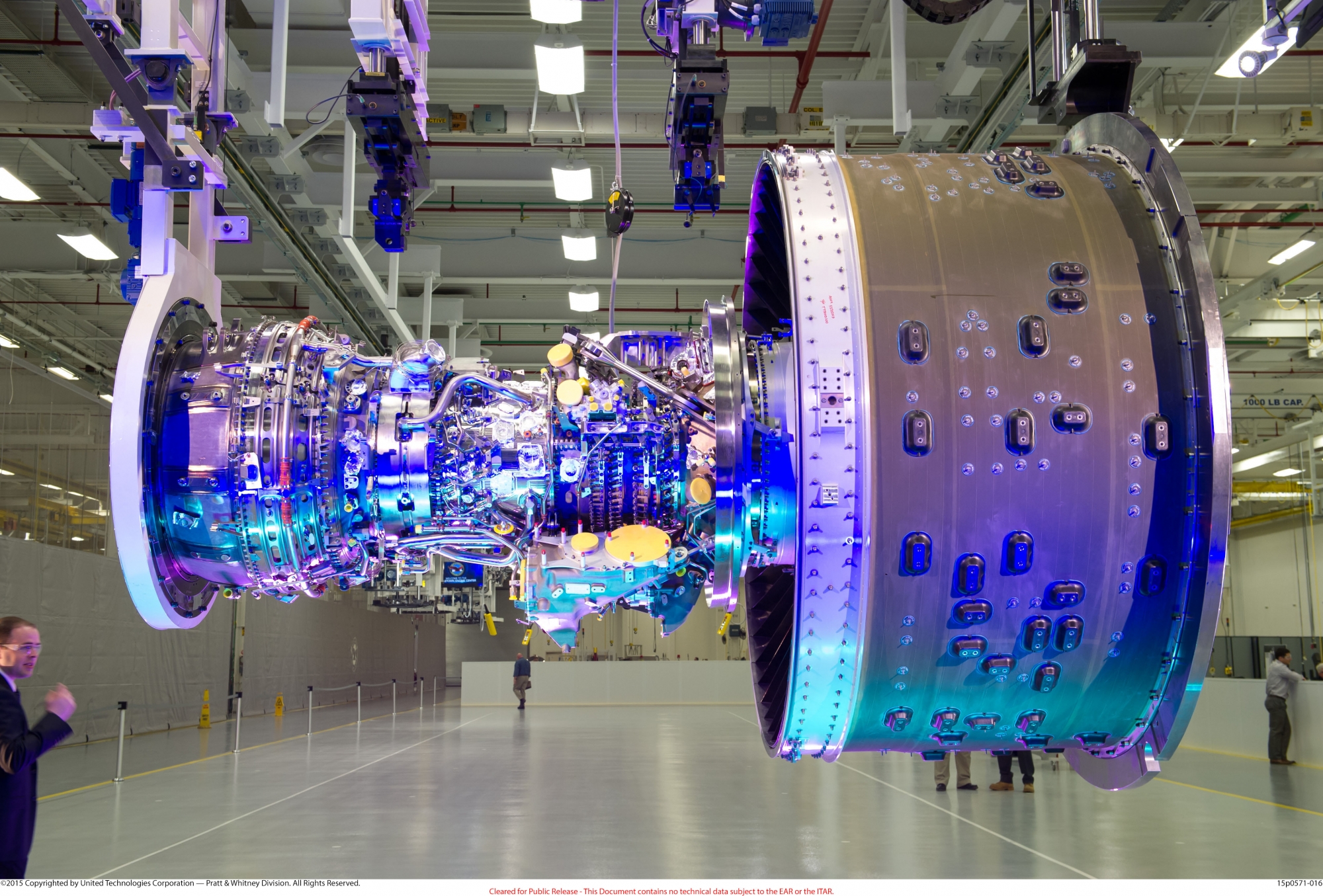
Pratt & Whitney is rolling out software and hardware fixes this summer that will reduce PW1100G start-up delays to between 90s and 100s, down from about 3min, the company tells Flightglobal.
The modifications come after some customers expressed dissatisfaction with a thermal issue that can cause the geared-turbofan engines to have much longer start-up delays than the industry standard of less than 1min.
The PW1100G’s start delay can be 3min, or 6min for a dual-engine start, P&W says. By comparison, CFM International has said its Leap-1A needs around 50s to cool before starting-up.
Both engines are both offered as power for Airbus A320neo-family aircraft.
P&W president of the aftermarket division Matthew Bromberg calls the required cooling cycle “a very common engine behavior”.
After the engines are shut down, rising heat causes a “temperature differential” between the top and bottom of the engine, which can cause a “slight bowing of the rotor” as the engine’s metal expands at different rates, he says.
The degree of bowing depends on factors including ambient air temperature and is only the “thickness of a hair”, Bromberg says.
Still, if the engine is started when the bowing is at its worst, a “harmonic vibration” can develop, he says.
”The engine will bounce a little… to the point where it can eat into the seals that are surrounding the blades,” according to Bromberg.
The problem does not occur if the engine is re-started shortly after it was shut down – when it is still warm – or after it has completely cooled, Bromberg says.
A software fix already incorporated into the engines measures how long the engine has cooled, and, if needed, causes the engine to initially spin slowly during a start, allowing the “temperature to even our across the motor”, says Bromberg.
Hence the 3min start.
P&W is further addressing the problem by applying a coating to some engine blades and strengthening the engine's third and fourth shaft bearings to prevent the harmonic vibration, Bromberg says.
"Then ultimately we are going to put coating on some of the blades that will improve the sealing function in the compressor," Bromberg says.
New PW1100Gs with the fix will ship this month and be installed on Airbus A320neos delivered this summer, while the handful of PW1100Gs already in service will be likewise be upgraded this summer, P&W says.
Only 10 PW1100Gs are currently in service on two A320neos operated by Lufthansa and three aircraft operated by IndiGo, though those carriers also have received several spare PW1100Gs, says Bromberg.
The start-up time requirement had led Qatar Airways, which was initially the Airbus A320neo launch customer, to delay initial aircraft deliveries. Qatar has orders for 34 A320neos and 16 A321neos, according to Flightglobal’s Fleets Analyzer database.
As a result, Lufthansa took the first A320neo.
Qatar chief executive Akbar al Baker had even threatened to cancel PW1100G orders in favour of Leap-1A powerplants, though earlier this month Al Baker expressed confidence P&W has addressed his concerns.
Bromberg says the geared turbofans have a 99% dispatch reliability rate and are meeting thrust, fuel burn and noise expectations.
P&W delivered 20 geared turbofans in 2015 and expects to deliver at least 200 in 2016, 400 in 2017 and 600 in 2018, the company tells Flightglobal.
U.S. Federal Aviation Administration has granted Boeing an amended type certificate for the new 737-7 airplane, clearing it for commercial service. The smallest...
flydubai will host its UAE National Careers Open Day on 16 August at the flydubai Campus, inviting UAE nationals to explore rewarding careers with one of the region’s fastest-growing airlines an...
Air India, SkyDrive and Suzuki Motor Corporation signed a memorandum of understanding to conduct a joint feasibility study on the use of eVTOL aircraft for medical air logistics in India. In...
Avelo Airlines reached a major milestone, flying its 10 millionth Customer just five years after redefining affordable air travel in as America's most convenient airline. Since launching on April...

