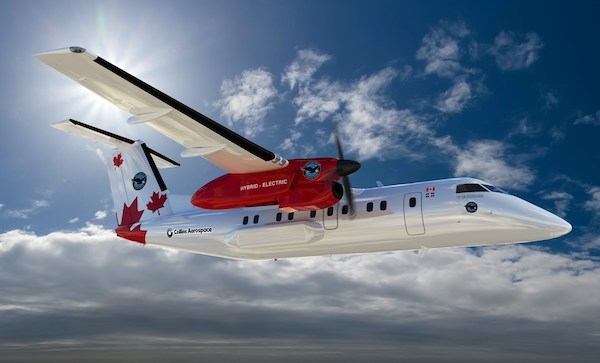
RTX achieved critical milestone in its hybrid-electric flight demonstrator program, successfully completing a rated power test of the demonstrator's 1 megawatt (MW) electric motor, developed by Collins Aerospace. The 1MW motor will be combined with a highly efficient thermal engine, developed by Pratt & Whitney, as part of a hybrid-electric propulsion system that aims to demonstrate a 30 percent improvement in fuel efficiency and CO2 emissions compared to today's most advanced regional turboprops. Collins and Pratt & Whitney are both business units of RTX.
Henry Brooks, president, Power & Controls for Collins Aerospace, commented: "With its industry-leading power density and efficiency, our 1MW motor will help to significantly reduce aircraft carbon emissions by supporting hybrid-electric propulsion architectures on the next generation of commercial platforms. As the motor's development continues apace, each milestone brings us one step closer to hybrid-electric flight and our industry's shared commitment to net-zero carbon emissions by 2050."
Jean Thomassin, executive director new products and services, Pratt & Whitney Canada, said: "Hybrid-electric propulsion technology offers significant potential to optimize aircraft efficiency across a range of future aircraft applications and is a key part of our technology roadmap for supporting more sustainable aviation. Aside from leveraging the deep expertise of Pratt & Whitney and Collins engineers within RTX, our project draws from extensive collaborations across Canada's aerospace ecosystem and around the world."
Compared to Collins' most advanced electric motor generators flying today, the 1MW motor will deliver four times the power and twice the voltage, with half the heat loss and half the weight. The company is developing the motor at Collins' facility in Solihull, United Kingdom, and testing it at the University of Nottingham'sInstitute for Aerospace Technology.
Following on from the first low speed engine run at a Pratt & Whitney Canadafacility in Longueuil, Quebec in December 2022, testing of the combined hybrid-electric propulsion system – including both thermal engine and 1MW motor – will continue through 2023. The propulsion system and batteries will be integrated on a Dash 8-100 experimental aircraft, with flight testing targeted to begin in 2024. The project is supported by the governments of Canada and Quebec.
In addition to the hybrid-electric flight demonstrator, the 1MW motor will also be part of the Pratt & Whitney GTF™ hybrid-electric powertrain planned for the SWITCH project under the European Union's Clean Aviation initiative. Future testing will be conducted at The Grid, the $50 million electric power systems lab at Collins' Rockford, Illinois, facility slated to open later this year.

Archived
3 years ago
For the fourth consecutive year, Corsair is reaffirming its commitment to the fight against breast cancer by partnering with the association "Les Hôtesses de l’Air cont...
A new travel industry coalition is urging EU policymakers to adopt a balanced and proportionate approach to biometric travel, ensuring passengers can benefit from secure and seamless journeys while ma...
UH-60 Black Hawk helicopters operated by Helicopter Alliance played a vital role in combating wildfires across Central and Southern Europe during the aerial firefighting season that has now concluded....
Azerbaijan Airlines (AZAL), part of AZCON Holding, has taken delivery of another Airbus A321neo, increasing its fleet to 31 aircraft as the carrier continues its long-term modernisation strategy. The...