



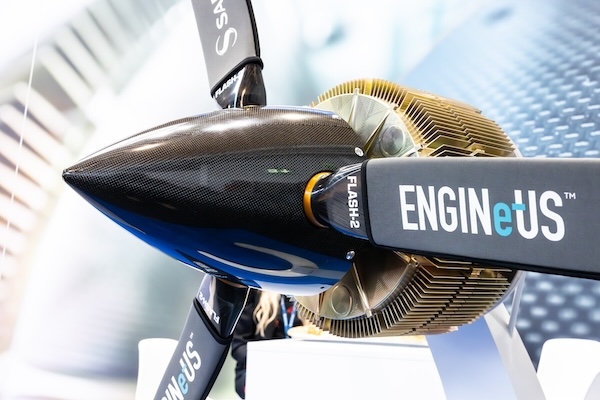
Safran Electrical & Power celebrates a world first: certification awarded by EASA of the ENGINeUS 100 motor – the first electric motor certified to power new air mobility. The motor obtained certification after a campaign involving 1,500 hours of motor certification tests and more than 100 flight hours on an aircraft in real-world conditions. It is the result of four years of collaboration with EASA to define the specific airworthiness rules for electric propulsion and design the right methods to properly assess and certify it.
Bruno Bellanger, CEO of Safran Electrical & Power commented: “We have just witnessed a key moment in the history of aviation. By obtaining certification for the ENGINeUS 100 electric motor, Safran Electrical & Power has achieved a world first. For Safran Electrical & Power and its institutional partners, this event represents an immense source of pride.”
Rachel Daeschler, EASA Certification Director stated: “This was a fascinating project for EASA, and the first test of our Special Condition designed for the certification of hybrid and all-electric propulsion. EASA is fully committed to support the development and certification of propulsion technologies aimed at decarbonizing aviation. We congratulate Safran for this key achievement, which is paving the way for electrification of aviation, for small airplanes and beyond.”
The ENGINeUS 100 electric motor is a whole host of innovations. Its design includes power and control electronics directly integrated into the motor. It can be easily integrated into all propulsion architectures, thanks to its compactness, lightness and its air cooling system. It delivers maximum power of 125 kW, with an unrivalled weight-to-power ratio of 5 kW/kg.
Safran Electrical & Power is preparing to mass-produce the ENGINeUS range with the creation of four semi-automated production lines in 2026 in Niort (France) and Pitstone (UK), enabling production of more than 1,000 electric motors per year, with capacity to increase production.
The ENGINeUS electric motor is designed to meet the varying requirements of the new mobility market thanks to its inherent ability to integrate into multiple architectures: from 100% electric propulsion for small two to four passengers aircraft, to distributed hybrid-electric propulsion for 19-passenger small regional transport aircraft, right up to the electric hybridization of future generations of commercial aircraft engines, capable of carrying 150 passengers. Many planemakers operating in new air mobility have already opted for Safran's ENGINeUS motor range or GENeUS motor-generators: AURA AERO, Bye Aerospace, CAE, Diamond Aircraft, Electra, TCab Tech, and VoltAero. The certification of the ENGINeUS 100 is a major milestone towards the production and market launch of the first aircraft.
Emirates has officially inaugurated services to Helsinki, marking a significant milestone in connectivity between Finland and the United Arab Emirates. The new daily route is the only year-r...
FL Technics Indonesia, the first MRO in Indonesia to be appointed as a GE Aerospace avionics support partner, has signed a service support agreement with GE Aerospace covering Boeing 737 and Airbus A3...
Following the successful public flight demonstrations at Expo 2025 Osaka, SkyDrive announced plans to undertake a feasibility study exploring the conversion of Osaka City’s existi...
A new travel industry coalition is urging EU policymakers to adopt a balanced and proportionate approach to biometric travel, ensuring passengers can benefit from secure and seamless journeys while ma...

