



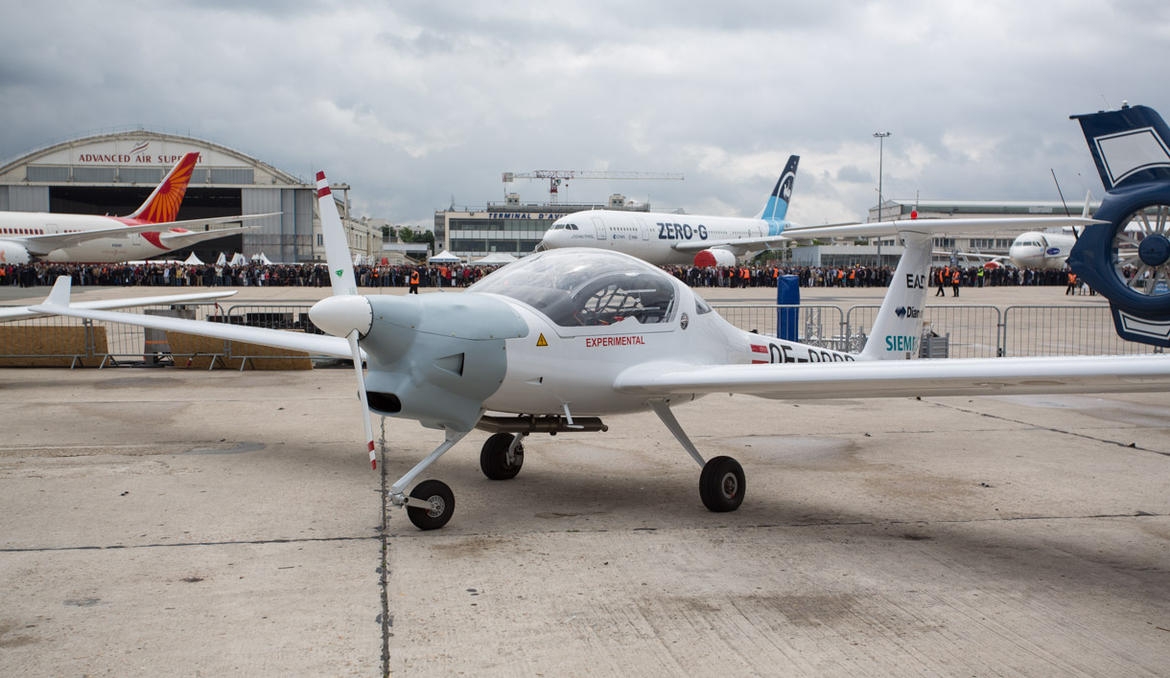
Electric vehicles are getting loads of attention withthe fury of Tesla 3 pre-orders, but wait, look up in the sky! About the same time the new Teslas showing up, Siemens and Airbus may have electric aircraft in the air.
The high tech pair set 2020 as the target for demonstration planes. They hope to have passenger aircraft with less than 100 seats powered by hybrid/electric propulsion systems by 2030. Together, they are committing 200 employees to make it happen. Clearly Siemens and Airbus think electric aircraft are the future, at least for shorter range flghts.
The advantages of all-electric or hybrid/electric aircraft engines are significantly reduced emissions and fuel consumption. Europe has set a high bar with a target of 75% CO2 emissions reduction by 2050 (compared to levels recorded in 2000) and Airbus and Siemens don’t believe that target can be reached with petroleum-fueled engines.
For passengers and crew, as well as often noise-beleaguered people who live near airports, another benefit will be the reduction in sound. There would be wind noise, of course, but what if aircraft were as quiet as golf carts? Clearly that would be much more pleasant than the wall of sound emanated from most current planes.
The planned prototypes on Airbus and Siemen’s wish-list will range from a “few 100” kilowatts, according to Airbus, to 10+ megawatts. The higher power levels would be appropriate for short and medium haul trips.
This joint alternative fuel engine project is not Siemens and Airbus Group’s first rodeo together. In 2011, they collaborated on a demonstration with Austria’s Diamond Aircraft. Since then, Siemens has been at work on an electric engine supplying five times the power of the 2011 demo, with no weight gain. In 2015, an Airbus electric-powered small plane made a channel crossing in a flight demonstrating their progress with the E-Fan. They now use that two-seater design to train pilots.
Near silent, non-polluting aircraft certainly sound like a good idea, but let’s hope no one’s counting on chargers in the sky. We can imagine that one day, there will probably be power “tankers” as there are today refueling planes aloft for jet fuel aircraft. That is likely to be a very quiet megakilowatt transfer. One thing we can all look forward to is thoroughly thought out on-board charging for our portable electronics.
MTU Maintenance and Garuda Indonesia have entered into a three-year agreement for the maintenance, repair and overhaul of the airline’s GE90-115B engines, which power its fleet of eight Boeing 7...
The Tennessee Valley Authority is demonstrating the real-world value of the Tecnam P2012 Special Mission Platform (SMP), which has become a vital tool for monitoring and maintaining its...
The U.S. Federal Aviation Administration has certified the Boeing 737-10, the newest and largest member of the 737 MAX family, paving the way for Boeing [NYSE: BA] to begin customer deliveri...
Bombardier marked the 40th anniversary of its industry-leading Smart Services cost-per-flight-hour programs, which today support more than 1,500 enrolled aircraft and account for over 11 mil...

