



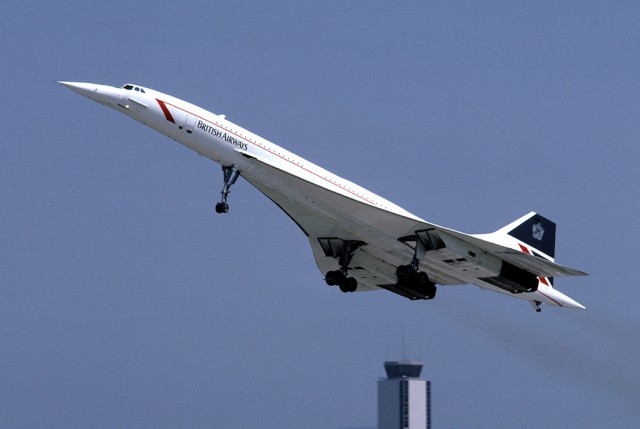
Supersonic airliners haven't flown since 2003, when the last Concorde was retired.
But could supersonic planes carrying large number of passengers make a comeback—and with electric power no less?
That's the vision of Luke Workman, a designer of lithium-ion battery packs who believes all-electric supersonic aircraft are attainable.
This belief is based around an axial-stack battery design, which integrates batteries with an aircraft's structure, according to New Atlas.
Making batteries a part of the airplane would allow for considerable weight savings, Workman claims.
The weight of current lithium-ion battery packs is one of the primary challenges facing designers of electric aircraft.

Instead of altering cell chemistry, Workman's concept radically alters structural design by essentially turning an airplane's wings into giant batteries.
In this scenario, the aluminum skin of the wings would be an integral part of a battery.
The full double-sided surface area of a wing would be used to collect current, with a cathode, anode, and electrolyte sandwiched in between.
Only the large wings of a supersonic airliner would have the necessary surface area for this concept to work, according to Workman, as a smaller-scale application would not offer enough capacity.
But that also means that the larger a wing gets, the more storage capacity it should have.
In theory, this would allow range to increase in proportion to the size of aircraft.

It's unclear whether such battery-electric aircraft will go into production anytime soon, but airlines are now under more pressure to reduce emissions.
Earlier this month, the United Nations' aviation agency approved plans to limit carbon emissions on international flights.
An agreement ratified by members of the UN International Civil Aviation Organization (ICAO) sets airlines' carbon emissions in the year 2020 as the ceiling of the total amount that will be legally allowed.
The international nature of air travel had previously made setting emissions limits difficult.
Aviation currently accounts for around 2 percent of global carbon emissions, but many analysts believe its share could triple by mid-century because of anticipated growth in air travel.
Boeing and Somon Air announced the delivery of the airline's first 737 MAX, as the Tajik national carrier continues to modernize its fleet and grow its network. The 737-8 is the first o...
ALTEA released a comprehensive Business Jet Pre-Sale Housekeeping Guide, designed to help owners address essential legal, technical, financial, and design details before bringing an aircraft to the ma...
Honda Aircraft Company announced first delivery of HondaJet Elite II in Brazil, marking a significant milestone in the company’s continued commitment to general aviation in South America. The de...
Summer high season in Spain is always a defining period for general aviation sector, and this year is no exception. With the first two months already behind us, preliminary results are offering a clea...

