



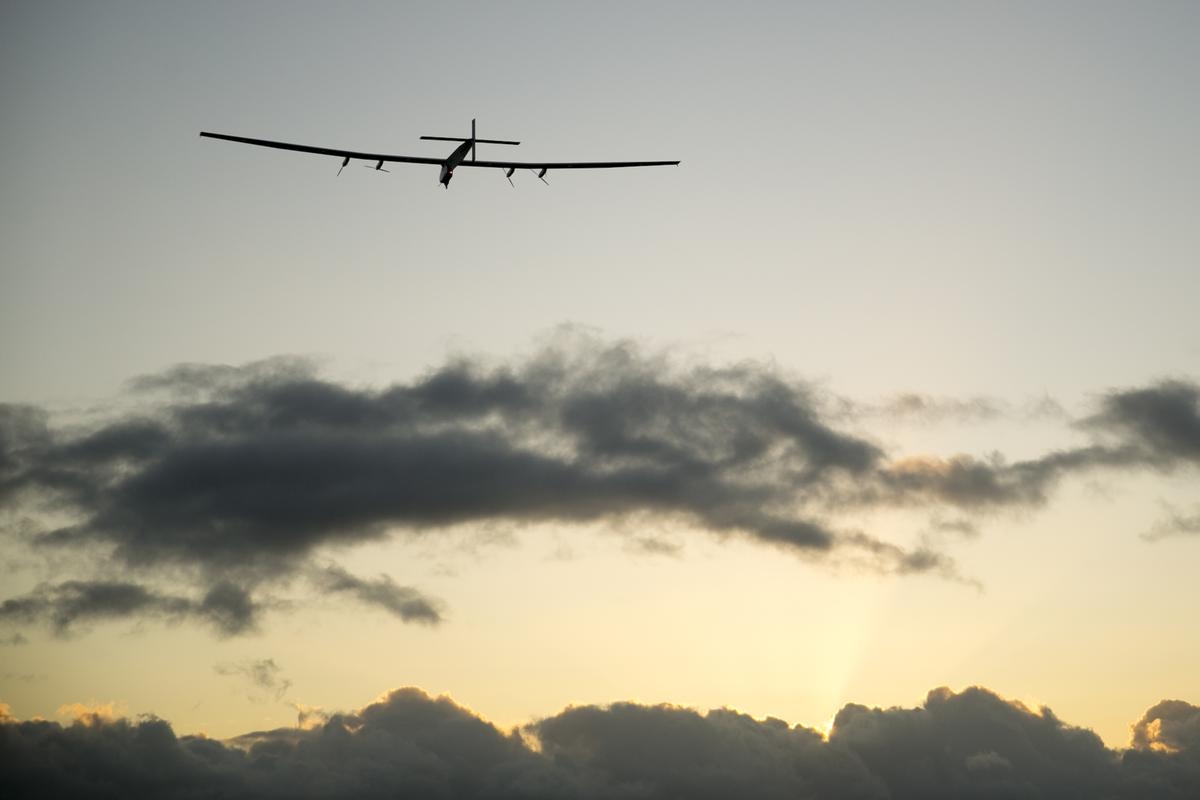
Two pilots are slowly carving their way into a new future of solar-powered flight as one embarks on the latest leg of their around-the-world journey in a plane powered only by the sun.
After some uncertainty about winds, the Solar Impulse team took off from Hawaii on Thursday, and hours later it was still ascending over the Pacific attempting to reach a high altitude before night sets in.
The Swiss-made Solar Impulse 2 was on course to land in Mountain View, California, in about three days. The crew that helped it take off was clearing out of its Hawaiian hangar and headed for the mainland for the weekend arrival.
The aircraft landed in Hawaii in July and was forced to stay in the islands after the plane's battery system sustained heat damage on its trip from Japan.
The aircraft started its journey in March 2015 from Abu Dhabi, the capital of the United Arab Emirates, and made stops in Oman, Myanmar, China and Japan. It's on the ninth leg of its circumnavigation.
Pilot Bertrand Piccard, who is flying the latest leg of the trip, said the idea of crossing the ocean in a solar-powered plane a few years ago stressed him out, but Thursday he was confident things would go according to plan.
Piccard also said the destination in the heart of Silicon Valley is fitting. He said on his way to the airfield that the plane will land "in the middle of the pioneering spirit."
Piccard's co-pilot Andre Borschberg, who flew the leg from Japan to Hawaii, told Piccard he greatly admires his dedication and strength.
He said the plane "represents what we could do on the ground in our communities."
The team was delayed in Asia, as well. When first attempting to fly from Nanjing, China, to Hawaii, the crew had to divert to Japan because of unfavorable weather and a damaged wing.
A month later, when weather conditions were right, the plane departed from an airport in Nagoya in central Japan for Hawaii.
The trans-Pacific leg is the riskiest part of the plane's global travels due to the lack of emergency landing sites.
The plane's ideal flight speed is about 28 mph, though that can double during the day when the sun's rays are strongest. The carbon-fiber aircraft weighs more than 5,000 pounds, or about as much as a midsize truck.
The wings of Solar Impulse 2, which stretch wider than those of a Boeing 747, are equipped with 17,000 solar cells that power propellers and charge batteries. The plane runs on stored energy at night.
The International Aircraft Dealers Association (IADA) has released its 2026-2027 Current Market Portrait & Forecast, offering an in-depth analysis of the global preowned business av...
A new travel industry coalition is urging EU policymakers to adopt a balanced and proportionate approach to biometric travel, ensuring passengers can benefit from secure and seamless journeys while ma...
Tecnam has announced a landmark strategic partnership aimed at accelerating the growth of its P2012 aircraft family across the United States. Under the agreement, Finnoff has been appointed the exclus...
British Airways has unveiled the next phase of its Heathrow lounge transformation programme, marking the beginning of a significant investment aimed at modernising every lounge across the airport in t...

