



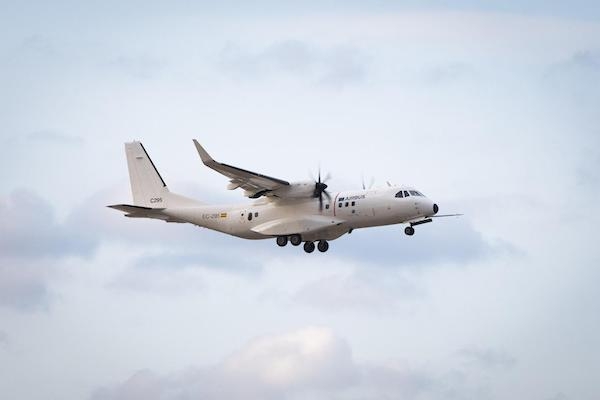
The Airbus C295 Flight Test Bed 2 has successfully performed its maiden flight from the Final Assembly Line in Seville. The aircraft now starts a flight campaign with the aim of testing the new semi-morphing wing, the new affordable flight control system, as well as a SatCom antenna embedded within the aircraft’s fuselage.
“The first flight of the C295 FTB2 is a key milestone that represents an important step forward in the programme, following the successful integration of the new aero structures, power-on and ground tests. A few years ago this programme was just a dream of a more sustainable future for aviation. Today we are at the final stage and we finally made it fly” said Francisco Javier Sánchez Segura, Executive Vice President Engineering Airbus Defence and Space.
Based on the Airbus C295, the Flight Test Bed 2 is an in-flight demonstrator of the European Clean Sky 2 (CS2) and the EU Horizon 2020 research and innovation programme, where technologies related to CS2’s future regional multimission aircraft are tested.
The modifications include new materials and technologies designed to achieve noise, CO2 and NOx emissions reduction. With these technologies applied in a future regional multimission configuration, up to 43% CO2 and 70% NOx reductions can be achieved in a typical Search and Rescue mission of 400 nautical miles, as well as 45% less noise during take-off.
The main modifications in the aircraft are a new high-efficiency semi-morphing wing, new dynamic winglets and a flat panel SATCOM antenna integrated within the top of the fuselage. In addition, innovative flight controls for primary control surfaces, including ailerons, flaps and flap tabs with improved aerodynamics, are capable of adjusting in-flight and contribute to a more efficient high lift system.
The new flight control system leverages digital control systems to optimise the aerodynamic shape of the wing in flight, while a new multifunctional flap has been completely redesigned and includes flap tabs in the trailing edge controlled by electro-mechanical actuators.
But the advantages also extend into the manufacturing process, not least with the use of advanced materials and manufacturing ranging from the use of Scalmalloy and additive manufacturing, to a new assembly method for the aero structures of the wing. A one shot assembly approach has been used for the new composite winglet and winglet tab, moving from the conventional ribs approach to a multi-spar integrated torsion box. Finally, jig-less methods have been used for the assembly of flaps and ailerons.
As a result, the C295 FTB2 brings improvements not only to the purely operational aspects of the aircraft, but helps introduce new improvement to the design and manufacturing process.
Bombardier announced plans to further expand its presence across the United States, with the creation of 800 jobs supported by ongoing growth initiatives and strategic infrastructure investments. ...
Asco, a subsidiary of Montana Aerospace AG, achieves significant technological milestone in the development of a hybrid multi-material Rear Secondary Structure for Airbus. Montana Aerospace,...
Private jet catering requires an understanding of the journey as much as the passengers' preferences. SkyDine Jet Catering explores how flight duration, departure schedules, airport location, and...
A professional training device such as the new PC-12 PRO simulator is built on flight data supplied and validated by Pilatus. Drawing on actual flight-test and performance data, it accurately reproduc...

