



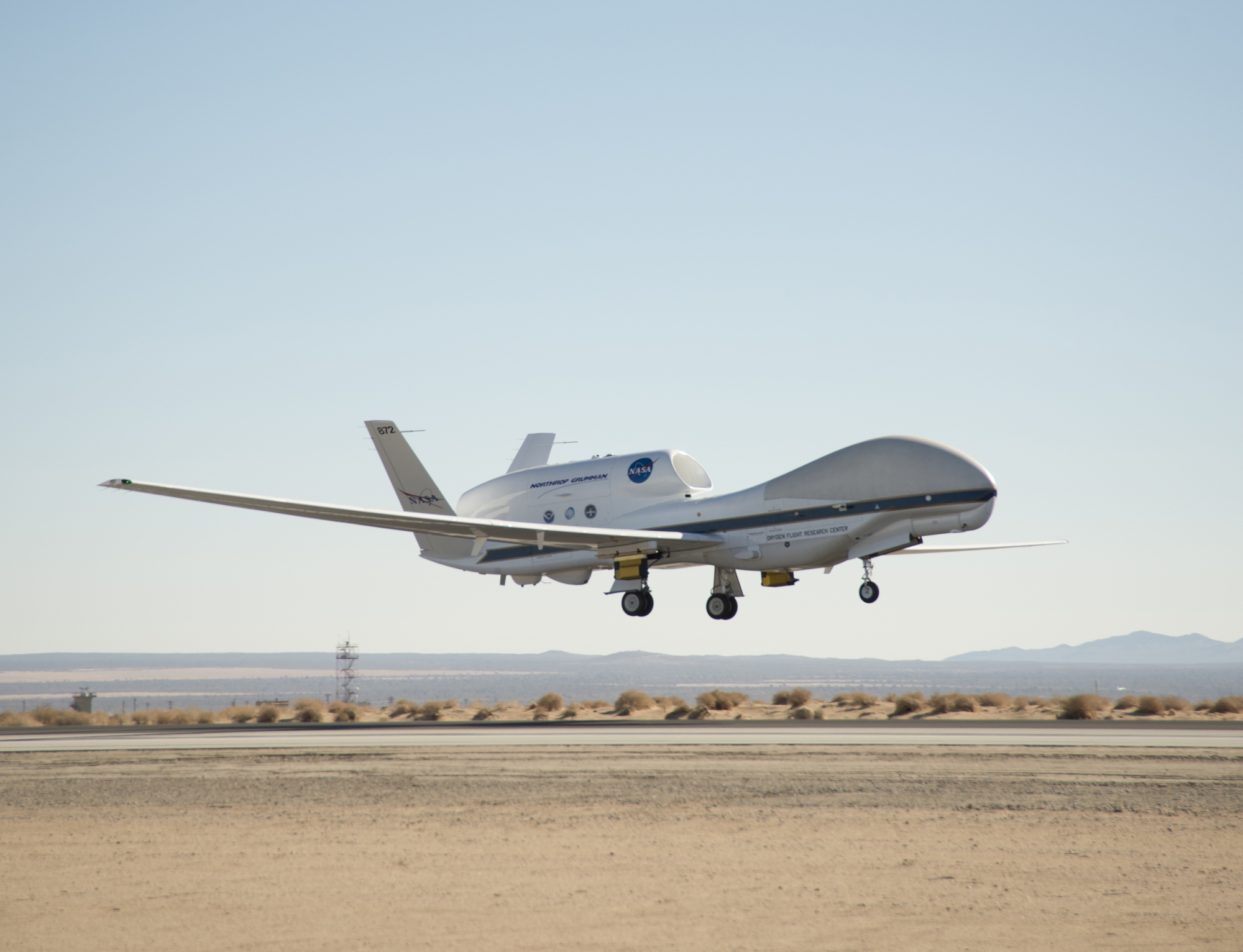
The U.S. Air Force is requesting information from industry on technologies that could produce lower-cost engines for future subsonic “Group 5” unmanned aircraft systems (UAS), the largest vehicles in the fleet with sizes and capabilities similar to the General Atomics Reaper or Northrop Grumman Global Hawk.
The request is linked to the Air Force’s Low Cost Attritable Aircraft Technology (LCAAT) initiative, aimed at using new design and manufacturing technologies to create Group 5 aircraft that cost less than $3 million each, not including mission systems.
“Attritable” refers to a vehicle that is somewhat disposable. “By virtue of its cost, loss of aircraft could be tolerated,” the Air Force says in the March 23 request for information, “however these aircraft would be intended for reuse with limited life/sorties.”
The Air Force launched the LCAAT program in June 2015, saying disposable long-range UAS for strike and ISR missions would provide the service with “game changing” capabilities, particularly in “contested and denied” environments where forward bases are not viable.
“This effort will design, develop, assemble, and test a technical baseline for a high speed, long range, low cost, limited life strike UAS,” the announcement stated. The Air Force plans to award a $7.45 million contract to one vendor for the 30-month effort, which is to include a flight demonstration.
For the LCAAT engine, the Air Force is starting with a technology survey “to determine the current and future states” of propulsion systems for long-range, high-subsonic-speed Group 5 UAS.
The service says that while legacy commercial-off-the-shelf (COTS) engines provide the necessary performance, the typical design life of 5,000 to 15,000 hours may be “financially unacceptable” for a disposable UAS. “A lower cost propulsion system with reduced life/reliability will be desirable,” the Air Force says, noting that technological improvements often make for smaller engines, but not necessarily lower-cost engines.
“The trade space between engine performance, life and cost is not well understood for engines in this size class,” the Air Force. says.
Tecnam introduces the P2008JC NG to the United States market, bringing flight schools a certified, next-generation training aircraft designed to dramatically reduce operating costs while maximizing fl...
Foster Aviation, the Dubai-based provider of Advanced Air Mobility and aviation solutions, and Aeroberm, a Skyportz company and developer of the patented modular vertipad system, have announced a...
PAL-V has signed a Memorandum of Understanding with AVION, a specialist in advanced flight training devices, and FLYVE, a developer of FlyDrive ecosystems for professional and government operator...
In a landmark step towards next-generation regional aircraft manufacturing, Jungheinrich has delivered an advanced automated logistics centre to Deutsche Aircraft at Leipzig/Halle Airport. Supporting...

